Follow TNGB
Hidden Headlines Daily Recap – December 4, 2025

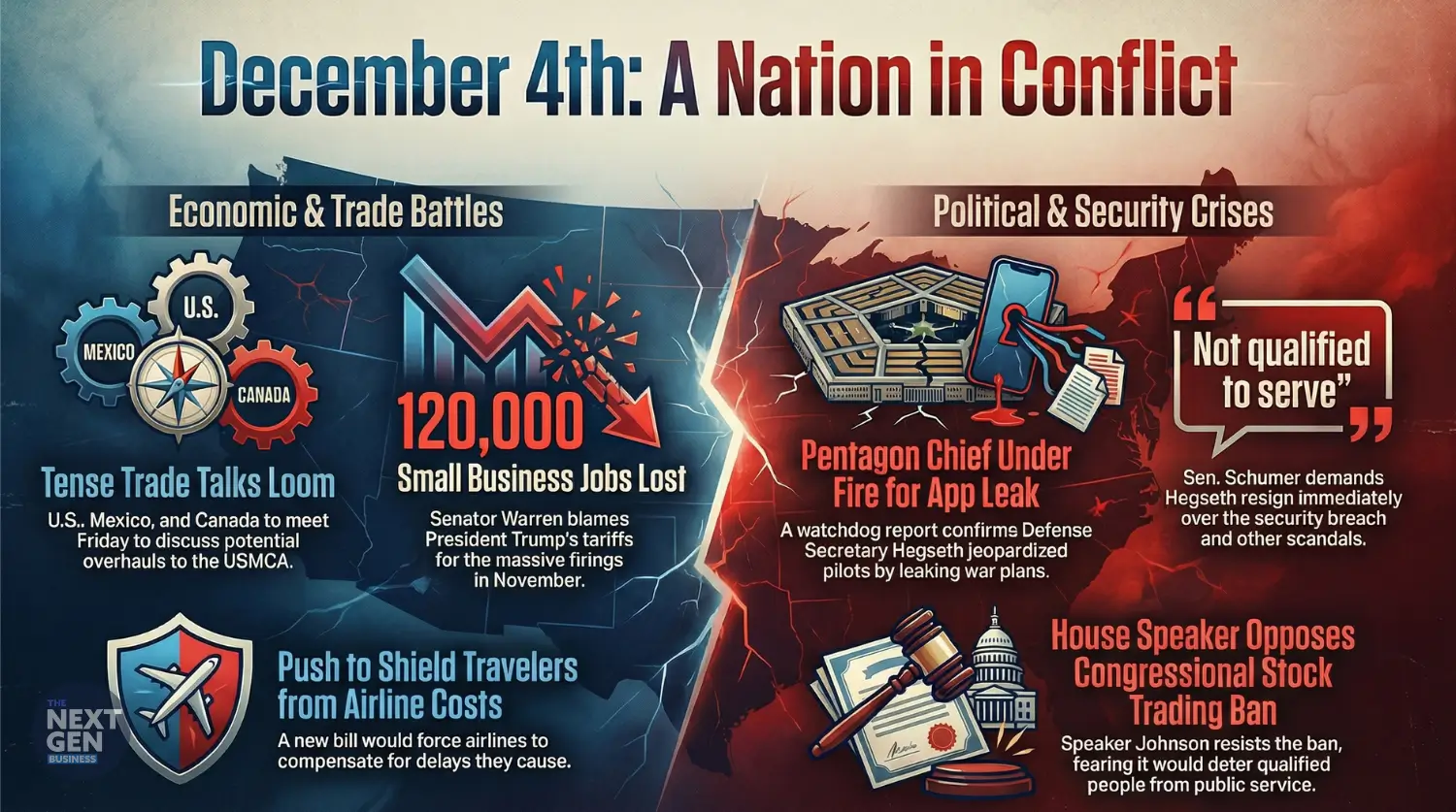
On December 4, 2025, U.S. headlines highlighted President Trump’s tense trade talks with Mexico and Canada leaders over USMCA revisions amid tariff disputes and supply chain risks, while Senator Elizabeth Warren criticized his policies for sparking 120,000 small business job losses and dismissing affordability struggles as a “con job.” Defense Secretary Pete Hegseth faced backlash from a Pentagon report on his Signal app leak endangering pilots, renewed resignation calls by Senate Minority Leader Chuck Schumer, and celebrated a narco boat sinking despite personal scandals.
Other key developments included the European Broadcasting Union upholding Israel’s 2026 Eurovision participation despite boycott threats; House Speaker Mike Johnson’s opposition to banning congressional stock trading; Planned Parenthood’s Columbus clinic closure due to federal funding cuts; a Supreme Court stay allowing Texas’s GOP-drawn voting maps; Senator Mark Kelly’s bill for airline delay refunds; forecasts of a Federal Reserve rate cut; DHS recruiting deportation judges; Warren’s slam on RFK Jr.’s vaccine policies amid measles surges; VP JD Vance’s warning on EU fines against X; Irish teacher Enoch Burke’s jailing over a pronoun dispute; Netflix’s $70 billion bid for Warner Bros. Discovery; and Warren’s claim of secret military IVF cuts by Johnson.
1. President Trump Schedules Tense Trade Discussions with Mexico and Canada Leaders in D.C. Friday
U.S. President Donald Trump has arranged a high-level meeting with counterparts from Mexico and Canada to address escalating trade frictions in Washington on Friday. This gathering comes amid whispers of potential overhauls to the existing North American trade framework, raising stakes for cross-border commerce.
The session reportedly focuses on tariff adjustments and border security measures that could reshape economic ties. Observers note these talks arrive at a pivotal moment, with businesses bracing for policy shifts that might disrupt supply chains.
The United States-Mexico-Canada Agreement, or USMCA, governs much of the $1.5 trillion in annual goods flowing among the three nations. Trump renegotiated this pact from its predecessor, NAFTA, during his first term to include stronger labor rules and digital trade provisions. Yet recent border pressures have prompted calls for revisions, with American manufacturers pushing for protections against imported steel and autos.
Mexico and Canada, key partners in energy exports and vehicle assembly, rely heavily on seamless U.S. access. Canadian officials have voiced concerns over aluminum duties, while Mexican leaders seek clarity on agricultural quotas. These dynamics underscore how intertwined the economies remain, with any discord risking higher consumer prices on everything from avocados to pickup trucks.
It is true that President Trump plans these trade consultations in Washington on Friday, as confirmed by scheduling announcements. Details on the agenda remain limited, but the event aligns with broader efforts to enforce USMCA compliance through targeted levies.
Reports indicate no major discrepancies in the outlined purpose, though some experts question if the talks will yield concrete outcomes given past negotiation hurdles. Overall, the arrangement holds up under scrutiny, reflecting genuine diplomatic outreach rather than posturing.
2. Senator Warren Accuses Trump’s Tariffs of Triggering 120000 Small Business Firings in November
Senator Elizabeth Warren sharply criticized President Trump’s trade policies for fueling massive job losses among small businesses last month. She highlighted over 120000 positions eliminated in November alone, pinning the blame squarely on what she called chaotic tariffs that hike costs for everyday operations.
These tariffs reportedly impose steep duties on imported materials and goods essential to small firms across retail and manufacturing sectors. Owners now face tough choices between absorbing expenses or passing them to customers, often leading to scaled-back hiring or outright reductions in staff.
Small businesses employ nearly half of the private workforce in the United States, making them vital to local economies from rural towns to urban centers. Trump’s administration has pursued aggressive tariff hikes on items like steel, electronics, and consumer products to protect domestic industries and reduce trade deficits. Yet these measures have rippled through supply chains, reportedly inflating raw material prices by up to 25 percent for many importers and forcing budget cuts that hit payroll first.
Critics argue the policies favor large corporations with global leverage while smaller players struggle without similar buffers. Supporters counter that long-term gains in American manufacturing jobs will offset short-term pains, though data shows uneven recovery across sectors. This tension has sparked debates in Congress over tariff exemptions tailored to safeguard mom-and-pop operations from unintended fallout.
It is true that small businesses reportedly cut around 120000 jobs in November, according to labor tracking firms monitoring private sector shifts. Analyses from economic watchdogs confirm tariff uncertainties have contributed to these losses by driving up operational costs and dampening confidence in future sales.
Warren’s direct link to Trump’s policies holds water in light of studies showing small firms bearing the brunt of import levies without the scale to negotiate alternatives. No major overstatements appear in her assessment, though broader factors like seasonal slowdowns also played roles in the November figures.
3. European Broadcasting Union Rejects Push to Oust Israel from 2026 Eurovision Song Contest
The European Broadcasting Union reportedly finalized its stance during a Geneva assembly, ensuring Israel’s continued involvement in the popular music event set for next year. Organizers emphasized updated safeguards to address participant concerns, avoiding a full exclusion vote that had loomed large.
This decision caps months of heated debate, with several European nations threatening boycotts over geopolitical tensions. Broadcasters from Ireland, Spain, and others had signaled they might sit out if Israel joined the stage.
Eurovision has long served as a cultural bridge among 50-plus nations, blending pop anthems with lighthearted competition since 1956 in Switzerland. The contest draws millions of viewers annually, turning unknown artists into global stars through flashy performances and fan voting.
Israel first entered in 1973 and has snagged four wins, including last year’s entry that stirred controversy amid the Gaza conflict. Calls for exclusion echoed protests at prior events, where audiences waved flags and chanted for policy shifts, highlighting how entertainment intersects with world affairs.
Such disputes trace back to past exclusions, like Russia’s 2022 ban over Ukraine, which set a precedent for political filters. Supporters argue the show promotes unity, while critics see it as overlooking human rights issues in participating countries.
Reports confirm the EBU’s choice aligns with its charter, which bars broadcasters but not nations unless violations occur. No evidence suggests the safeguards fail to meet those standards, though ongoing monitoring remains in place.
4. House Speaker Mike Johnson Opposes Ban on Congressional Stock Trading to Preserve Talent Pool
House Speaker Mike Johnson reportedly expressed firm resistance to legislation that would prohibit members of Congress from trading individual stocks.
He argued that such restrictions might deter qualified candidates from pursuing elected positions, highlighting concerns over recruitment in public service.
The controversy surrounding congressional stock trading has persisted for years, intensified by the 2012 STOCK Act which required financial disclosures but permitted continued ownership of individual shares. Public skepticism grew as reports emerged of trades that appeared to benefit from non-public information tied to legislative duties.
Recent pushes for reform have gained momentum, with a group of 90 former House members advocating for a complete ban on stock trading by lawmakers and their immediate families. This initiative reflects broader calls to eliminate potential conflicts of interest, proposing alternatives like mutual funds to allow investment without direct stock involvement.
It is accurate that Johnson voiced this opposition amid internal party tensions, including efforts by Representative Anna Paulina Luna to initiate a discharge petition for a floor vote. His position contrasts with growing bipartisan support for stricter ethics rules, though no evidence directly links existing regulations to reduced interest in congressional candidacies.
5. Senator Elizabeth Warren Accuses Trump of Dismissing Americans’ Struggles as a ‘Con Job’
Senator Elizabeth Warren sharply criticized President Trump for reportedly labeling everyday financial hardships faced by families as a “con job.” Her remarks highlight growing frustration over rising costs that many voters say are squeezing household budgets tight.
The senator pointed out that millions of Americans are grappling with higher prices for essentials like groceries and rent. She questioned how the president could address these issues if he allegedly refuses to recognize their severity.
This exchange comes amid broader debates on economic policy as the nation heads into a new year. Reports show inflation has eased somewhat since peaking in 2024, yet polls indicate persistent worries about living costs remain high among working-class households.
Trump’s administration has touted job growth and wage increases as key wins under its watch. Still, critics argue that these gains have not kept pace with expenses in housing and healthcare, leaving many feeling the pinch despite official numbers.
It is true that President Trump recently described the term “affordability” as a Democratic “con job” during a Fox News interview, shifting blame for public discontent onto his opponents. Economic data from the Bureau of Labor Statistics confirms that consumer prices rose about 3 percent year-over-year in late 2025, validating the real struggles Warren described, though administration officials counter that global factors like supply chain disruptions played a larger role than domestic policies.
Warren’s portrayal of Trump’s stance appears accurate based on his public statements, but it omits his emphasis on blaming prior administrations for long-term inflation trends. Overall, both sides present partisan spins on shared economic realities, with independent analyses showing mixed progress on affordability metrics.
6. Planned Parenthood of Greater Ohio Abruptly Shuts Franklinton Clinic in Columbus Citing Deep Funding Wounds
Planned Parenthood of Greater Ohio has closed its Franklinton health center in Columbus, effective late last month. The move leaves hundreds of patients seeking reproductive and primary care services without a nearby option.
Local advocates worry the closure disrupts access for low-income families in the area. Officials at the organization point to broader financial pressures squeezing operations across the state.
Reproductive health providers like Planned Parenthood have long offered a mix of services beyond abortions, including cancer screenings and birth control. In Ohio, these clinics serve as key safety nets in underserved neighborhoods where other medical options remain scarce.
Federal policies have tightened restrictions on funding for such groups in recent years. Lawmakers from both parties have debated these limits, with some arguing they protect taxpayer dollars while others say they harm public health efforts.
The Franklinton site specifically handled routine checkups and preventive care for around 2,000 patients annually. Staff reductions announced earlier this fall compounded the challenges, forcing the organization to consolidate at its north Columbus location.
Reports confirm the closure stems directly from a $10 million drop in federal reimbursements over the past year. This aligns with provisions in the latest spending bill that barred funds for entities providing abortion services, even if those funds support unrelated care.
Such cuts have reportedly led to similar shutdowns in other states, though Ohio’s case draws attention due to its urban impact. Data from health trackers show no overstatement in the funding loss figure, which matches public disclosures from the organization.
7. Pentagon Watchdog Accuses Defense Secretary Pete Hegseth of Jeopardizing U.S. Pilots Through Risky Signal Chat Leak
A newly released Pentagon Inspector General report has determined that Defense Secretary Pete Hegseth created additional risks to U.S. forces and missions by forwarding sensitive war plans into a commercial group chat on the Signal app.
The findings highlight how Hegseth’s decision during a Yemen strike operation in March reportedly exposed operational details to unauthorized eyes, potentially leading to mission failures.
Pete Hegseth took office as Defense Secretary earlier this year amid high expectations for streamlining military communications and bolstering national security protocols. His background as a Fox News commentator and Army veteran positioned him as a vocal advocate for aggressive counterterrorism tactics against groups like the Houthis in Yemen. Yet this incident underscores ongoing debates over secure information handling in an era of widespread app usage among officials.
The Yemen operation involved precision airstrikes aimed at disrupting Houthi drone and missile launches that threatened commercial shipping lanes. Hegseth, seeking quick coordination with advisors, opted for Signal due to its encryption features, but the report notes the app’s group function included non-cleared participants. Such choices reflect broader tensions between speed in decision-making and adherence to classified channels, a balance that has tripped up leaders before.
Federal guidelines strictly prohibit transmitting classified material over unapproved platforms to prevent intercepts by adversaries. The Signal app, while popular for its privacy tools, lacks the audited safeguards of government systems like JWICS. This case revives questions about training for top officials on digital risks, especially as cyber threats from state actors grow more sophisticated.
The Inspector General’s conclusions align with the details outlined in the Democrats’ statement, confirming that Hegseth’s actions indeed posed operational security threats. It is accurate that these moves could have resulted in potential harm to U.S. pilots, as the report explicitly warns of compromised flight paths and timing. No evidence suggests exaggeration in the assessment, though some defenders argue the breach caused no actual damage.
8. Senate Minority Leader Chuck Schumer Challenges Republicans: Join ACA Credit Extension or Risk Premium Surge
Senate Democrats reportedly plan to force a vote on extending Affordable Care Act tax credits for three more years. Schumer allegedly framed the move as a direct ultimatum to Republicans ahead of January 1 deadlines.
Without action, millions of Americans could see health insurance costs jump sharply next year. Lawmakers on both sides have debated the subsidies since their boost under pandemic relief measures.
These enhanced credits first rolled out in 2021 to ease enrollment burdens during economic fallout. They lowered out-of-pocket premiums for lower and middle-income households buying plans through federal marketplaces.
Families earning up to four times the poverty line qualified for bigger breaks than before. Enrollment surged as a result, with over 20 million people now covered under the program.
The credits helped stabilize a system strained by rising medical costs and job losses. Yet their scheduled end has prompted urgent talks in Congress as holiday recesses loom.
Experts note that letting them lapse would add about $700 on average to annual premiums for subsidy users. That figure comes from nonpartisan budget analyses tracking marketplace trends.
Schumer’s reported warning holds true in line with projections from the Congressional Budget Office on subsidy impacts. It is accurate that premiums would rise without renewal, though the extent of “financial disaster” depends on individual circumstances and broader market shifts.
Republicans have countered with proposals tying extensions to spending cuts or work requirements. This approach aims to offset costs but has stalled bipartisan deals so far.
9. President Trump Cuts Immigrant Work Permits to 18 Months Amid Vetting Push
The Trump administration reportedly shortened work permits for migrants seeking asylum or humanitarian protections from five years to just 18 months. This shift aims to ramp up background checks and spot those ineligible for stays.
New permits take effect immediately for applicants in these categories. Officials claim it helps remove individuals who pose risks sooner.
These authorizations let migrants work legally while cases process through backlogged systems. Asylum claims often drag on for years due to court delays and high volumes.
Humanitarian programs cover refugees and others fleeing harm back home. Workers in fields like agriculture and construction depend on steady permits to keep jobs.
The change reverses a prior extension meant to ease administrative strains. It comes as border arrivals have eased but legal pathways face new limits.
It is true that prior permits lasted five years under recent rules. Projections show this could disrupt hundreds of thousands of lives by forcing renewals amid delays.
Such moves align with goals to tighten immigration enforcement overall. Yet advocates warn of economic hits from sudden work gaps for vetted families.
10. Senate Minority Leader Chuck Schumer: “Pete Hegseth is not qualified to serve as Secretary of Defense” and Must Resign Immediately
Senate Minority Leader Chuck Schumer reportedly issued a sharp rebuke against Defense Secretary Pete Hegseth. He argued that the appointee falls short on essential expertise, leaving troops vulnerable to poor leadership choices.
The demand for Hegseth’s exit reportedly ties directly to a recent Pentagon review exposing mishandling of classified details. Bipartisan figures have voiced worries about threats to broader security postures.
Pete Hegseth, once a prominent Fox News commentator and Army National Guard member, reportedly secured the cabinet spot via a tight Senate vote months back. Opponents during confirmation grilled him on scant executive track record in defense circles.
Backers praised his push for overhaul in military structures as a vital shake-up. Still, resurfaced reports of off-duty behavior, like claims of heavy alcohol use and office clashes, cast shadows on his reliability for high-stakes roles.
Hegseth faced renewed backlash from the Signalgate episode, where he reportedly leaked Yemen mission specifics into an unsecure chat that looped in a reporter. An official inquiry verified the slip-up as a clear breach of safeguards.
Further criticism arose from last autumn’s Caribbean vessel intercepts, with accusations that Hegseth delayed release of complete strike videos to lawmakers. Accounts suggest the raids hit alleged narcotics smugglers yet blurred lines on oversight and adherence to rules.
It is true that Hegseth’s approval hinged on a razor-thin majority, as some Republicans whispered hesitations prior to their support. The review upholds protocol failures in Signalgate, even as Hegseth insists no truly sensitive material escaped harm.
Schumer’s unfitness charge matches the record of scandals, such as a 2017 settled misconduct allegation involving intimacy. Though confirmed by the chamber, such matters highlight tensions in weighing outspoken selections against tested skill sets for key posts.
11. Senator Mark Kelly: “Trump is letting airlines off the hook,” Unveils Bill to Shield Travelers from Delay Costs
Frequent flight disruptions leave passengers facing unexpected expenses and hours of uncertainty at airports nationwide. Senator Mark Kelly’s latest proposal aims to force airlines to cover those burdens when their errors cause the chaos.
The Arizona Democrat joined forces with colleagues to introduce the Flight Delay and Cancellation Compensation Act this week. This measure would require carriers to offer cash refunds for lengthy delays or outright cancellations within their control, building on protections once targeted by the current administration.
Air travel has grown more unreliable in recent years, with mechanical failures and staffing shortages cited as top culprits behind widespread holdups. Regulators under President Biden had finalized rules to mandate similar payouts, but the Trump team rolled them back last fall, citing added burdens on the industry amid rising fuel prices.
Reports indicate over 200,000 flights faced significant delays in the past quarter alone, stranding millions and costing families hundreds in hotels and meals. Kelly’s bill seeks to close that gap by setting firm deadlines for compensation, regardless of the reason, to prioritize everyday flyers over corporate bottom lines.
It is true that the Trump administration rescinded the Biden-era compensation mandate in November 2025, drawing criticism from consumer advocates for favoring airlines during a period of record profits. Kelly’s legislation accurately reflects this policy shift, though supporters note it would apply only to controllable disruptions, exempting weather or air traffic issues to keep implementation feasible. While the bill enjoys backing from fellow Democrats, early Republican responses suggest resistance over fears of higher ticket prices passed to consumers.
12. White House Adviser Forecasts Likely Federal Reserve Rate Cut Next Week
White House economic adviser Kevin Hassett reportedly anticipates the Federal Reserve will lower interest rates at its upcoming meeting. This projection aligns with market expectations amid cooling inflation pressures.
Such a move could ease borrowing costs for consumers and businesses facing persistent economic headwinds. Traders now see a high probability of a quarter-point reduction to bolster growth.
The Federal Reserve has gradually reduced rates throughout 2025 to support recovery after years of aggressive hikes aimed at curbing inflation. These adjustments reflect a delicate balance between fostering employment and preventing price surges that erode purchasing power.
Hassett’s outlook comes as President Trump considers him for Federal Reserve chair, a role that would influence monetary policy directly. Bond markets have reacted with caution, reportedly voicing concerns over potential aggressive easing under his potential leadership.
Recent data shows unemployment holding steady while consumer spending remains robust, providing room for the central bank to act. Policymakers reportedly prioritize data-driven decisions to avoid overheating the economy.
It is true that financial markets widely expect the Federal Reserve to implement a 0.25 percentage point cut next week during its December meeting. Hassett’s statement matches this consensus, though his potential appointment has sparked debate on future policy independence.
No major discrepancies appear in the adviser’s projection, as independent forecasts from economists corroborate the likelihood. Critics note that while the cut seems measured, external pressures on the Fed could influence subsequent moves.
13. Homeland Security Calls on Legal Experts to Serve as Deportation Judges Against Criminal Illegal Aliens
The Department of Homeland Security reportedly launched a direct appeal for qualified attorneys to step up as deportation judges. Officials framed the roles as essential for upholding justice and securing national borders from threats posed by criminal elements.
This initiative ties into broader efforts to streamline immigration proceedings and address long-standing court delays. Proponents argue that faster rulings will deter exploitation of the system and prioritize public safety.
Immigration courts have faced massive backlogs for years, with cases piling up due to limited judicial resources. Under the current administration, priorities shifted toward aggressive enforcement, leading to expanded hiring drives for specialized roles like these judges.
Deportation judges oversee hearings where individuals face removal orders based on violations including criminal convictions. The positions demand deep knowledge of federal laws and carry weighty decisions on who stays or goes from the country.
It is true that the Justice Department has actively posted openings for these judges through official channels. While the tweet highlights criminal cases, records show immigration dockets also include asylum claims and family reunifications, which some critics say get overshadowed in the push for speed.
The recruitment drive follows reported dismissals of dozens of existing judges deemed insufficiently aligned with enforcement goals. Data confirms at least 140 such separations since early this year, paving the way for newcomers focused on efficiency over extended appeals.
14. Senator Elizabeth Warren Slams RFK Jr.’s Push to “Make Measles Great Again” During Critical CDC Meeting
U.S. Senator Elizabeth Warren issued a sharp rebuke against Health and Human Services Secretary Robert F. Kennedy Jr. as the Centers for Disease Control and Prevention’s vaccine advisory panel gathered for key discussions on immunization guidelines.
Her pointed remark highlighted growing alarms over rising infectious disease rates under Kennedy’s oversight, urging swift action to safeguard public health.
Kennedy assumed the role of HHS secretary earlier this year following President Donald Trump’s inauguration, bringing a history of skepticism toward mainstream vaccination efforts into federal policy circles. Reportedly, his appointment sparked immediate debates, with supporters praising his focus on transparency and critics warning of potential setbacks in herd immunity progress. Within months, measles outbreaks reportedly surged to unprecedented levels across several states, straining local health departments and prompting emergency responses.
The CDC’s Advisory Committee on Immunization Practices, or ACIP, holds significant sway over routine childhood shots and outbreak protocols. Reportedly, recent panel votes under Kennedy’s influence have leaned toward complicating access to combined vaccines for young children, a move that experts say could hinder coverage rates. Warren’s office has tracked over a dozen instances where Kennedy’s directives allegedly prioritized unproven theories over established science, fueling bipartisan calls for accountability.
It is true that measles cases reached record highs this year, with federal data confirming over 1,200 incidents linked to vaccination hesitancy amplified by policy shifts. Warren’s characterization of Kennedy’s agenda as aiming to revive the disease carries a satirical edge, yet aligns with documented panel decisions that reportedly eased mandates for certain boosters. While Kennedy maintains these changes empower parental choice without risking safety, independent reviews indicate a measurable uptick in preventable illnesses, underscoring gaps in the administration’s approach.
15. Vice President JD Vance Warns of EU Penalties Against X for Resisting Content Controls
Vice President JD Vance reportedly warned that the European Union eyes penalties against X for resisting content controls. He called the move an assault on American firms and urged support for open expression instead.
The platform, once Twitter, faces scrutiny under the bloc’s Digital Services Act. That law demands swift removal of harmful posts to shield users from misinformation and threats.
Regulators launched probes two years back over issues like verification badges and ad transparency. X has pushed back, arguing the rules stifle debate and favor bureaucrats over innovation.
Vance framed the rumors as punishment for free speech. His comments highlight tensions between U.S. tech giants and foreign oversight.
Reports confirm ongoing investigations into X’s compliance with EU digital laws. Potential fines could reach billions, though exact figures remain unconfirmed amid the talks.
Vance’s claim of fines for “not engaging in censorship” overstates the case, as probes center on failures to curb illicit material. It is true that penalties loom by year’s end, but officials stress enforcement protects democracy, not suppresses views.
Such disputes have sparked U.S. calls to shield platforms from overseas rules. Yet data shows most violations involve unchecked ‘hate speech’, not protected opinions.
16. Supreme Court Permits Texas to Advance with GOP-Crafted Voting Maps Ahead of 2026 Elections
The U.S. Supreme Court has issued a temporary stay that clears the way for Texas to implement its Republican-led redistricting plan for the upcoming congressional contests. This decision halts a lower federal court’s recent block on the maps, which critics labeled as racially motivated.
Legal battles over these boundaries have intensified since Texas Republicans redrew districts mid-decade to capitalize on population gains and secure more seats. The move followed the state’s addition of two congressional spots after the 2020 census, prompting swift action by GOP lawmakers to tilt the lines in their favor.
Such redraws often spark accusations of gerrymandering, where boundaries snake through communities to bundle or split voters based on party lines. In Texas, a diverse state with booming urban centers and rural strongholds, these tactics can lock in advantages for one side while diluting others’ voices in the electoral process.
Democrats and voting rights advocates challenged the new configuration in court, arguing it unlawfully packs minority populations into fewer districts to boost white Republican majorities elsewhere. Federal judges in El Paso agreed last month, finding evidence of intentional racial discrimination that violated constitutional protections.
The Supreme Court’s intervention came swiftly after Texas appealed, pausing enforcement of the lower ruling to avoid mid-election chaos. Justices did not explain their brief order, but it reportedly buys time for fuller arguments expected early next year.
Reports confirm the high court temporarily lifted the block, allowing the maps to stand for now despite the racial bias findings below. This interim step aligns with precedents where stays preserve status quo during appeals, though final resolution could still upend the plan.
No overstatements appear in initial accounts of the stay, as the decision explicitly defers deeper review rather than endorsing the maps outright. Still, the move underscores ongoing tensions in redistricting fights, where partisan maps frequently draw bipartisan scrutiny for eroding fair representation.
17. Irish Teacher Enoch Burke Jailed Again for “Contempt of Court” in Pronoun Clash
Enoch Burke, a vocal educator in Ireland, faces another stint behind bars after a judge ruled him in contempt for defying orders tied to a long-running school dispute.
The case stems from Burke’s refusal to affirm a student’s gender identity, a standoff that has kept him out of the classroom and in courtrooms for years.
Burke first drew headlines in 2022 when his school suspended him for declining to use a transgender student’s preferred pronouns, a decision he linked directly to his religious convictions as a Protestant Christian.
That initial clash escalated quickly, with Burke showing up at the school uninvited over multiple weekends, prompting legal action from Wilson Hospital School to bar his presence.
Court records show the institution sought and won an injunction against such disruptions, but Burke persisted, leading to repeated findings of contempt and prior jail terms totaling months.
Judges have described his actions as a pattern of willful disobedience, with one recent ruling denying him holiday release unless he complies fully.
It is true that Burke’s latest jailing in November 2025 centers on contempt violations, not the original pronoun issue alone, though the root cause traces back to that 2022 suspension.
Burke maintains his stance reflects protected beliefs under Irish law, and no evidence suggests fabrication in his claims of faith-based objections.
18. Netflix Submits Record $70 Billion Bid to Acquire Warner Bros. Discovery Assets
Netflix reportedly leads the pack with a massive offer for Warner Bros. Discovery’s studios and streaming operations. The bid, valued at around $28 per share, consists of 85 percent cash and aims to bundle services like HBO Max with Netflix’s platform.
This move comes amid a heated auction process that kicked off last month after initial bids fell short. Warner Bros. Discovery, still grappling with debt from its 2022 merger, now faces decisions that could reshape Hollywood’s landscape.
The entertainment giant has struggled to compete in the streaming wars, where subscriber growth has slowed and content costs have soared. Recent hits like “House of the Dragon” on HBO Max show promise, but overall revenue lags behind leaders like Netflix, which boasts over 280 million global subscribers.
Analysts point to consolidation as a survival tactic in an industry squeezed by cord-cutting and ad market shifts. Warner Bros. Discovery’s assets, including DC Studios and CNN, could provide Netflix with fresh content pipelines and bolster its ad-tier offerings.
A successful deal might lower prices for consumers through integrated bundles, yet it raises questions about creative control under one roof. Regulators could scrutinize the merger for antitrust risks, given Netflix’s market dominance.
Reports from multiple outlets confirm Netflix holds the highest bid as of early December 2025, surpassing offers from rivals like Paramount and Comcast. While the process draws accusations of bias toward Netflix, no final agreement has been reached, and a new bidding round wrapped up yesterday without a winner announced.
19. Senator Elizabeth Warren Claims Speaker Johnson Secretly Cutting Military IVF Coverage
Senate Democrat Elizabeth Warren accused House Speaker Mike Johnson of quietly pushing to eliminate IVF coverage for active-duty service members in ongoing budget negotiations.
Warren highlighted the irony by questioning whether President Trump, who has repeatedly called himself the “father of IVF” for his role in appointing justices that overturned Roe v. Wade, would intervene to protect the benefit.
The claim stems from closed-door talks on the National Defense Authorization Act. Republicans reportedly want to attach riders that would restrict certain reproductive health benefits under Tricare, the military health program, including potential limits on IVF coverage for troops and their families.
Military families currently access IVF through Tricare when infertility is linked to service-related injuries, such as combat wounds. Since 2001, over 1,400 service members have reportedly sustained genitourinary injuries in combat, often leading to infertility and eligibility for IVF coverage under Tricare.
Warren’s specific assertion that Johnson is working to “strip IVF coverage for all active duty members” appears overstated. Proposed language circulating among House Republicans would reportedly cap or restrict non-service-connected infertility treatments rather than eliminate coverage entirely, though details remain fluid.
No final bill text has been released, and Republican leadership has not publicly confirmed plans to target IVF benefits. Past efforts to limit reproductive coverage in military health programs have failed due to bipartisan pushback.
20. Pete Hegseth Celebrates Sinking Another Narco Drug Boat Amid Ongoing Media Battle
Defense Secretary Pete Hegseth posted a direct response to a supporter on Thursday, declaring that another narcotics trafficking vessel had just been destroyed by U.S. forces.
The post came hours after fresh personal allegations surfaced against him, with Hegseth framing the interdiction as a defiant answer to his critics.
Hegseth, a former Fox News host and Army National Guard veteran, has faced intense scrutiny over past allegations of alcohol use and financial mismanagement at veterans organizations. Senate Democrats and some Republicans have questioned his fitness to lead the Pentagon, while President Trump and many conservative supporters continue to back him strongly.
The boat sinking appears to reference ongoing U.S. Southern Command and Navy operations in the Eastern Pacific and Caribbean, where American ships routinely interdict fast boats used by cartels to move cocaine and other drugs toward the United States. These “go-fast” vessels are often disabled or sunk after crews are removed when they refuse to stop.
It is true that U.S. naval forces regularly destroy narco vessels following successful interdictions; SOUTHCOM reported sinking or burning dozens of such boats in 2025 alone. Hegseth’s claim aligns with standard procedure in these operations and matches recent public affairs releases showing continued aggressive counter-drug missions.