Follow TNGB
Hidden Headlines Daily Recap – December 3, 2025

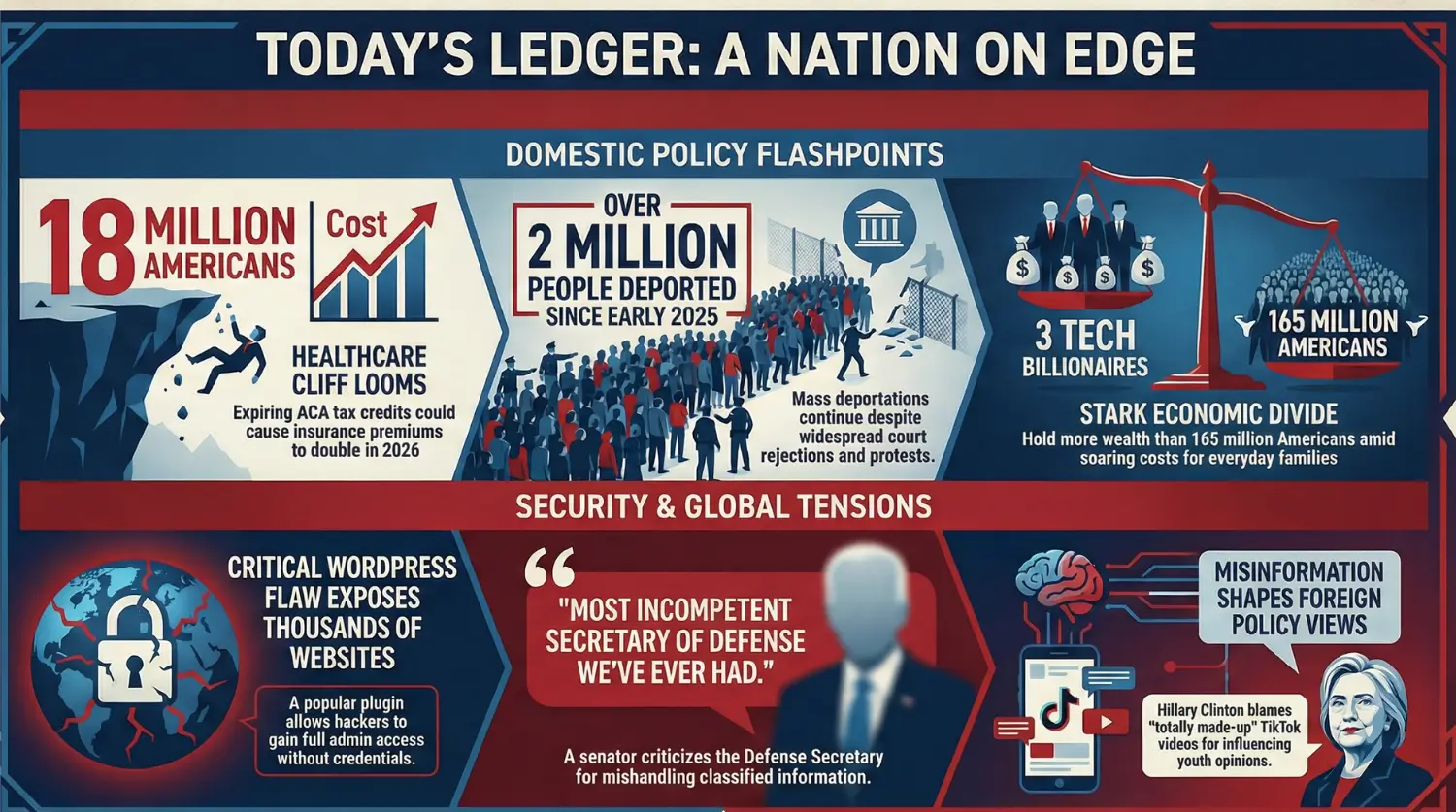
On December 3, 2025, U.S. political headlines highlighted urgent health care debates, with House Minority Leader Hakeem Jeffries urging Republicans to extend ACA tax credits via discharge petition to prevent premium spikes for millions, while Senate Minority Leader Chuck Schumer warned of a “healthcare cliff” due to expiring subsidies and accused GOP inaction during a record 43-day shutdown. Immigration dominated discussions, as Jeffries praised Trump’s secure border but called for broader reforms; the White House affirmed ongoing mass deportations despite court blocks; NATO’s Matt Whitaker labeled illegal migration a global security threat; and Venezuela resumed U.S. deportation flights under pressure.
Economic tensions surfaced with Schumer rebutting Trump’s “hoax” claim on affordability amid inflation woes, Bernie Sanders decrying tech billionaires’ wealth surpassing half of Americans, and Speaker Mike Johnson celebrating four months of falling rents. Other notes included Sen. Joni Ernst’s bill to bar SNAP benefits at fast-food chains, Hillary Clinton blaming TikTok misinformation for youth Palestine views, Rep. Nancy Mace eyeing a South Carolina governor run, Sen. Mark Kelly slamming Defense Secretary Pete Hegseth over security lapses, and a critical WordPress plugin vulnerability exposing thousands of sites to hacks.
1. House Minority Leader Hakeem Jeffries Calls on Republicans to Back Extension of ACA Tax Credits Saving Coverage for Millions
House Minority Leader Hakeem Jeffries reportedly urged a handful of Republicans to support a discharge petition aimed at extending Affordable Care Act tax credits before they expire. This effort seeks to maintain affordable health insurance for tens of millions of Americans who could otherwise face sharp premium increases.
The enhanced credits, boosted amid the COVID-19 crisis, reportedly help limit costs for those buying plans on the marketplaces. Without renewal, households at certain income levels might pay much more monthly starting in 2026.
Democrats launched the discharge petition recently to bypass regular committee processes and force a floor vote. The three-year extension would provide stability during enrollment periods when people choose coverage options.
Republicans control the chamber and have suggested linking any extension to budget reductions or stricter rules. Advocates say the credits have expanded access but add to federal spending over time.
It is accurate that Jeffries is pushing for the extension through a discharge petition with broad Democratic backing. However, the House Democratic caucus stands at 213 members, not 214, with over 200 signing the petition so far, and given Republicans’ 219 seats, five GOP signatures are needed to reach the 218 threshold for discharge.
2. House Minority Leader Jeffries Credits Trump for Secure Border Yet Lambasts Lingering Immigration Flaws
House Minority Leader Hakeem Jeffries reportedly praised President Trump for achieving a secure southern border during a recent CNN appearance. He noted that such progress merits recognition, even as broader immigration challenges persist under the current administration.
Jeffries highlighted how the border’s stability developed on Trump’s watch, calling it a positive outcome worth acknowledging. Still, he stressed that tackling core immigration concerns demands far more comprehensive action.
The U.S.-Mexico border has seen dramatic shifts since President Trump’s second term began in early 2025. Federal agencies like Customs and Border Protection report monthly illegal crossings plummeting below 10,000, a level unseen in over 50 years, thanks to aggressive enforcement measures including expanded wall construction and rapid deportations.
These policies have slashed encounters by more than 90% from the prior administration’s highs, easing strains on border resources and local communities. Officials attribute the drop to deterrence tactics that signal zero tolerance for unlawful entries, though critics argue they overlook root causes like economic pressures in migrant-sending nations.
Deeper immigration reforms, such as pathways for legal workers or asylum overhauls, remain stalled in Congress amid partisan gridlock. Jeffries’ remarks underscore a bipartisan frustration that enforcement wins alone fail to resolve systemic issues, including backlogged visa processing and integration for long-term residents.
Data from federal trackers confirms Jeffries’ assertion that the border now stands secure, with nationwide apprehensions averaging under 8,000 monthly in late 2025. This aligns with official tallies showing historic lows in illegal crossings, validating the credit given to Trump’s oversight on that front.
His critique of unresolved immigration matters holds as an opinion rooted in legislative inaction, where bills for comprehensive fixes have repeatedly faltered. While enforcement metrics are accurate, the statement highlights a partisan lens that downplays ongoing debates over humanitarian aid versus strict controls.
3. WordPress Sites Under Siege as King Addons Flaw Enables Easy Admin Takeover
A critical flaw in the popular King Addons for Elementor plugin reportedly allows hackers to gain full admin access on WordPress sites without any login credentials. Security teams have blocked over 48,000 attack attempts exploiting this vulnerability since October.
This breach exposes thousands of websites to complete takeovers, where attackers can upload malicious files or steal sensitive data with ease. Web developers using the plugin face urgent risks, as exploitation ramps up across global servers.
WordPress powers more than 40% of all websites worldwide, making it a prime target for cybercriminals seeking quick gains. The King Addons plugin, designed to enhance Elementor page builders with extra widgets and templates, has drawn over 10,000 active installations before the patch.
Such add-ons often promise seamless customization but introduce hidden risks if not vetted properly. Users typically install them for free features that speed up site design, yet outdated versions leave doors wide open for remote code execution alongside the admin escalation issue.
Federal records show two linked vulnerabilities, one for broken access controls and another for privilege escalation, both rated at the highest severity level. Immediate updates to version 51.1.37 reportedly fix these holes, but many sites lag behind due to auto-update hesitancy.
It holds true that attackers have actively targeted this flaw, with confirmed exploits leading to site hacks in recent weeks. The figure of 48,000 blocked attempts aligns with firewall logs from major security providers, though actual successful breaches remain underreported.
4. NATO Ambassador Matt Whitaker Warns Illegal Immigration ‘Unsustainable,’ Destabilizes U.S. and World Security
U.S. Ambassador to NATO Matt Whitaker reportedly called illegal immigration a global crisis that threatens stability on both sides of the Atlantic. He urged allies to join America’s cleanup efforts amid rising security risks from unchecked border crossings.
The statement comes as the Trump administration ramps up deportations and pauses certain visa programs from high-risk nations. Whitaker’s remarks highlight how porous borders fuel transnational threats that no single country can handle alone.
Illegal immigration has surged in recent years, with millions entering the U.S. without authorization and straining resources in border states. Federal data shows enforcement actions hit record highs in 2025, targeting criminal networks tied to drug trafficking and human smuggling.
These flows reportedly overwhelm local communities, where schools and hospitals face added burdens from unvetted arrivals. Meanwhile, European allies grapple with similar waves from Africa and the Middle East, prompting joint NATO discussions on migration’s role in hybrid warfare.
It is true that illegal immigration contributes to security challenges, including increased fentanyl smuggling and gang activity linked to cartels. However, economic analyses reveal mixed impacts, with some studies showing immigrants fill labor gaps while others highlight net fiscal costs exceeding $150 billion annually.
Claims of worldwide destabilization hold partial weight, as migration pressures exacerbate conflicts in origin countries and strain alliance cohesion. Yet, experts note that targeted reforms, not blanket blame, better address root causes like poverty and violence abroad.
5. White House Affirms Mass Deportations Will Press Ahead Despite Widespread Court Rejections
The White House reportedly issued a stark declaration this week, stating that mass deportations of illegal immigrants will keep rolling out under President Trump’s directive.
This comes as federal agents have ramped up operations across major cities, targeting those without legal status amid heated debates over border security.
Federal data shows over two million illegal immigrants have faced removal or self-deportation since early 2025, a figure touted by administration officials as proof of effective enforcement.
Yet community advocates point to rising family separations and workplace raids that snag long-term residents, fueling protests in states like Texas and California.
Immigration policy has long divided the nation, with surges in crossings at the southern border straining resources and local economies since the early 2020s.
The current push builds on promises from Trump’s campaign, aiming to prioritize criminals but often sweeping up others in broad sweeps.
Judges have reportedly blocked more than 220 deportation orders in recent months, including some from Trump appointees, citing procedural flaws and rights violations.
Administration leaders maintain these efforts deter future illegal entries, though independent trackers note many removals involve non-violent cases.
It is true that deportations have accelerated, with Department of Homeland Security figures confirming the two million milestone by late summer, aligning with White House goals for quicker turnarounds.
However, reports from policy analysts indicate the pace falls short of the largest-ever operation pledged, hampered by legal hurdles and limited detention space, without exaggeration from either side.
Claims of unchecked continuation overlook ongoing bipartisan pushback, including Democratic bills to restrict temporary judge hires, which could slow proceedings further.
7. House Democrats Charge Republicans Ignored Health Care for 43 Days on Vacation Amid Record Shutdown Blame
House Democrats reportedly fired back at Republicans with a sharp critique on the stalled health care talks. They claimed zero days spent battling for affordable coverage since Congress returned from recess, contrasted against 43 days of what they called vacation time.
The pointed message highlighted Republican ownership of both a brewing health care squeeze and the nation’s longest government closure ever. Lawmakers face a year-end rush to extend subsidies that keep insurance premiums in check for millions.
This tension stems from a massive federal shutdown that gripped the country from early October through mid-November 2025. It lasted a full 43 days after Democrats in the Senate blocked funding bills that omitted billions in tax credits for Affordable Care Act plans.
Those credits have slashed costs and boosted enrollment to all-time highs since their expansion a few years back. Without renewal by December’s end, experts warn premiums could jump 50 percent or more starting next year, hitting working families hardest.
The shutdown erupted over partisan clashes on spending priorities, with Republicans pushing clean funding extensions. Democrats held firm, insisting on tying reopenings to health protections they view as lifelines for everyday Americans.
Negotiations dragged on, furloughing thousands of federal workers and delaying services from park upkeep to food aid checks. President Trump eventually signed a stopgap measure in November, but it kicked the health subsidy fight down the road without resolution.
It is true that the 2025 shutdown marked the longest in U.S. history at 43 days, surpassing the 35-day record from 2018 to 2019. Both parties traded blame during the standoff, though Republicans controlled the House while Senate Democrats used procedural tools to demand the ACA fixes.
The vacation jab appears overstated, as the shutdown period involved active sessions and deal-making rather than full recesses for lawmakers. A standard Thanksgiving break followed the closure’s end, but current talks show bipartisan efforts underway despite the fresh partisan sparring.
8. Senate Minority Leader Chuck Schumer Fires Back at Trump Over Affordability Woes No Hoax Just Real Pain
Senate Minority Leader Chuck Schumer reportedly took aim at President Donald Trump this week. He insisted that “affordability is not a ‘hoax'” as families grapple with skyrocketing costs for basics.
Schumer’s sharp rebuke came after Trump allegedly labeled concerns about everyday expenses a “Democrat scam” during a recent Cabinet meeting. The exchange highlights deepening partisan rifts over the economy just months into Trump’s second term.
Voters across the country have voiced frustration with persistent inflation pressures that began years ago. Grocery bills have climbed roughly 25% since 2020 while housing costs have surged even higher in many urban areas.
These trends trace back to supply chain disruptions and energy shocks from the pandemic era. Federal policies on both sides of the aisle have aimed to curb the rise but with mixed results so far.
Trump’s administration has touted tax cuts and deregulation as quick fixes for growth. Yet critics point to proposed tariffs that could further inflate import prices on consumer goods.
Schumer and fellow Democrats have pushed for targeted relief like expanded child tax credits and housing subsidies. Republicans counter that such measures fuel spending without addressing root causes like illegal immigration’s impact on labor markets.
It is true that affordability remains a top worry for most Americans according to recent polls from Gallup and Pew. Around 70% of respondents report difficulty covering essentials tying it to broader economic unease.
Schumer’s claim that Trump’s policies bear direct blame holds partial weight as new trade barriers have coincided with a 3.2% uptick in core inflation this quarter. However data from the Bureau of Labor Statistics also shows cooling trends in energy and wages outpacing prices for some demographics.
The partisan framing overlooks shared factors like global events that neither side fully controls. Both leaders have exaggerated their fixes while downplaying ongoing challenges for working families.
9. Senator Joni Ernst Unveils Bill to Halt SNAP Benefits at Fast-Food Outlets Nationwide
Iowa Republican Senator Joni Ernst has introduced legislation aimed at closing a federal loophole that lets low-income Americans use food assistance for quick-service meals.
The proposal targets the Restaurant Meals Program, which currently operates in nine states and allows Supplemental Nutrition Assistance Program recipients to buy prepared foods at participating eateries.
This program started years ago to help elderly, disabled, and homeless individuals who struggle with cooking or storing groceries. Over time, it expanded to include chains like Subway and Taco Bell in areas with high participation rates. Critics argue it strays from SNAP’s core goal of promoting balanced diets through grocery purchases.
Supporters of reform point to recent data showing hundreds of millions in taxpayer funds going toward burgers and fries instead of fresh produce. Ernst’s office reportedly gathered figures indicating over $500 million spent this way in just two years, with California alone accounting for nearly 90 percent of that total. The bill seeks to standardize rules across the country by requiring congressional approval for any restaurant expansions.
It is true that the McSCUSE ME Act, as Ernst calls it, would effectively ban SNAP use at fast-food spots unless states get specific federal okay. Ernst’s claim about the spending levels aligns with USDA records on the program, though opponents note these meals often serve vulnerable groups facing real access barriers. While the push highlights waste concerns, it overlooks how such options prevent food insecurity for those without kitchen facilities.
10. Republicans Have Sent America Barreling Toward a Healthcare Cliff, Senate Minority Leader Chuck Schumer Charges
Senate Minority Leader Chuck Schumer issued a stark warning about the looming expiration of Affordable Care Act tax credits. He pointed to Republican resistance in Congress as the force pushing millions of families closer to unaffordable medical bills.
These subsidies, enhanced during the pandemic, currently shield about 18 million Americans from steep insurance costs. Without swift action, households could face average premium jumps that double their out-of-pocket expenses starting next year.
The Affordable Care Act rolled out in 2010 to broaden health coverage through marketplaces where people shop for plans. Lawmakers later boosted tax credits under the American Rescue Plan to cap contributions at levels tied to income, drawing in record enrollment numbers.
Those changes eliminated the so-called subsidy cliff, letting middle-income earners qualify for aid that previously cut off sharply. Now, with the boosts due to lapse after December 31, experts project widespread fallout in access to care across states.
Open enrollment kicked off last month amid this uncertainty, prompting shoppers to lock in 2025 rates before changes hit. Advocacy groups urge lawmakers to prioritize extensions to avoid marketplace disruptions that could echo earlier volatility.
It is true that the enhanced credits will vanish without renewal, based on projections from health policy analysts showing average premiums rising 114 percent for marketplace enrollees. Schumer’s figure aligns with estimates affecting tens of millions, though actual impacts vary by location and family size, with some seeing smaller hikes while others drop coverage entirely.
While the warning highlights a real policy deadline, it overlooks bipartisan talks on reforms that could tweak rather than fully restore the subsidies. This framing underscores Democratic pressure on Republicans holding the Senate majority, yet fiscal watchdogs note the credits’ annual cost tops $100 billion, fueling debates over long-term funding.
11. Venezuela Reportedly Resumes U.S. Deportation Flights Under Pressure from President Trump
Venezuelan leaders announced Tuesday that the country will once again accept flights carrying deported nationals from the United States. This decision follows a brief suspension sparked by President Trump’s threat to close Venezuelan airspace entirely.
The resumption highlights ongoing tensions between Washington and Caracas over migration enforcement. Officials in both nations confirmed the flights will operate twice weekly, carrying around 200 people each time.
Ties between the U.S. and Venezuela have long strained under economic sanctions and disputes over oil exports. President Nicolas Maduro’s government previously halted deportations in response to U.S. policy shifts, forcing migrants to other destinations like Mexico.
This year’s deportations mark a shift from Maduro’s earlier refusal to accept returnees amid a mass exodus driven by hyperinflation and shortages. Over 13,000 Venezuelans have returned via these chartered flights operated by U.S. contractors and state airlines.
Human rights groups have raised concerns about conditions for deportees upon arrival, including limited support services. The Trump administration views the program as key to targeting criminal networks like the Tren de Aragua gang linked to drug trafficking.
Reports indicate the flights paused after Trump’s airspace declaration last weekend, which also affected commercial routes. Venezuelan Foreign Minister Yvan Gil made the request public, noting approval for landings at Maiquetia International Airport near Caracas.
It is true that Venezuela has agreed to resume these deportation flights at the Trump administration’s request, reversing a short halt tied to the airspace dispute. The claim of Maduro’s government “caving” reflects diplomatic pressure, though officials frame it as cooperative on humanitarian repatriation rather than outright concession.
Deportation numbers align with government data showing steady returns since early 2025, without evidence of exaggeration in the totals reported. Critics note the policy overlooks broader asylum claims from Venezuelans fleeing persecution, but enforcement prioritizes verified removals over comprehensive vetting.
12. Hillary Clinton Pins Young Americans’ Palestine Views on TikTok’s ‘Totally Made-Up’ Videos
Former Secretary of State Hillary Clinton reportedly sparked debate by linking a surge in youth support for Palestine to deceptive content flooding TikTok feeds. She described these clips as pure propaganda that warps perceptions without a shred of truth.
Clinton made the remarks during a recent panel discussion on digital media’s grip on democracy. Her comments highlight growing worries over how short-form videos shape opinions among those under 30.
The Israel-Palestine conflict has long divided generations, with older Americans often viewing it through traditional news lenses. Younger crowds, however, turn to apps like TikTok for quick takes, where algorithms push emotionally charged posts that stick.
This shift worries leaders across the aisle, as polls show stark gaps in sympathy levels by age group. Clinton’s take underscores fears that unvetted online bursts could deepen divides on foreign policy matters.
Experts note that while social platforms amplify voices from all sides, fact-checkers have flagged numerous misleading Gaza clips. Clinton’s stance aligns with broader calls to regulate tech giants amid rising misinformation complaints.
It is true that Clinton specifically blamed TikTok for promoting “totally made-up” videos that fuel anti-Israel sentiments among youth. Her words, delivered in a public forum, echo verified reports of viral fakes but overlook how similar biases appear on other apps.
Critics argue her focus singles out one platform, potentially downplaying verified atrocity footage shared widely. Still, data from media watchdogs confirms a spike in deceptive content tied to the conflict, validating her core concern without excusing oversimplification.
13. Senator Bernie Sanders Exposes Tech Giants’ Grip: Musk, Bezos, and Zuckerberg Reportedly Hold More Wealth Than Bottom Half of Americans
Millions of American families reportedly face daily battles to afford basic groceries amid soaring costs. Senator Bernie Sanders highlighted this stark divide by noting that three tech billionaires now control a fortune exceeding the combined assets of the nation’s poorest 165 million people.
Such concentration of riches has reportedly intensified public frustration over economic fairness. Sanders pointed out that this setup defines an oligarchy where a handful of elites shape policies favoring their interests.
Wealth gaps in the United States have widened dramatically over the past decade due to factors like stock market surges and tax policies. Tech leaders like Elon Musk, Jeff Bezos, and Mark Zuckerberg saw their fortunes balloon through company valuations tied to innovations in space, e-commerce, and social media.
These executives built empires that transformed daily life for billions yet sparked debates on fair compensation for workers. Critics argue that unchecked growth in executive pay and corporate profits leaves average earners behind while fueling calls for reforms like higher minimum wages.
The bottom half of Americans holds roughly $3.7 trillion in total wealth according to recent economic analyses. Meanwhile the trio’s combined net worth has surpassed $880 billion driven by rising shares in Tesla, Amazon, and Meta.
Sanders’ claim aligns with data from financial trackers showing their assets indeed outpace the lower 50 percent. While the figures fluctuate with markets the overall trend confirms a growing imbalance that stokes widespread anger over perceived economic rigging.
14. Speaker Mike Johnson Celebrates Fourth Straight Month of Falling Rents for American Families
House Speaker Mike Johnson reportedly hailed the latest drop in national rents as a vital boost for everyday households.
He pointed to four months of declines as proof that Republican measures are easing financial strains built up over recent years.
This trend stems from a surge in apartment construction that outpaced demand in many regions. Vacancy rates have climbed to all-time highs, giving renters more choices and leverage in negotiations.
Landlords now face pressure to lower asking prices to fill units quickly. Families once squeezed by high housing costs can finally redirect savings toward groceries or savings accounts.
The national median rent reportedly dipped one percent in November to stand at $1,367 per month. This marks the fourth consecutive monthly fall, confirming Speaker Johnson’s claim about the ongoing relief.
Such declines have varied by city, with larger drops in Sun Belt areas hit hard by new supply. Experts note that while welcome, these shifts alone may not fully offset broader inflation impacts on budgets.
15. Rep. Nancy Mace Signals Potential Early Departure from Congress to Pursue South Carolina Governorship
Rep. Nancy Mace of South Carolina reportedly weighs leaving her House seat ahead of schedule to focus on a 2026 gubernatorial campaign. This move could trigger a special election in her solidly Republican district, where recent voter shifts elsewhere raise questions about the outcome.
Mace, a three-term congresswoman known for her independent streak within the GOP, holds the First Congressional District that leans heavily conservative. Her potential exit comes amid a crowded Republican primary for governor, featuring Attorney General Alan Wilson and others vying to succeed term-limited Gov. Henry McMaster.
The district, which Donald Trump carried by 13 points in 2020, has remained a GOP stronghold through multiple cycles. Yet national trends show suburban voters in similar areas drifting toward Democrats on issues like abortion rights and economic pressures, complicating replacements for incumbents who depart.
South Carolina’s political landscape favors Republicans at the state level, with the party controlling the legislature and most executive posts. Mace’s bid aligns with her push for tax cuts and deregulation, themes that resonate in a state reliant on tourism and manufacturing, though critics question her alignment with party hardliners.
Reports indicate Mace plans a decision soon, following a key consultant’s abrupt exit from her team over ideological clashes. This internal friction highlights tensions between establishment figures and Trump loyalists, as Mace navigates a primary that could test her appeal to the base.
It remains unconfirmed whether Mace will formally retire early, though sources close to her campaign suggest active preparations for the governor race point in that direction. Her district’s partisan lean holds true based on recent analyses, with Trump winning it by roughly 13 points four years ago, underscoring its reliability for Republicans absent major disruptions.
The referenced swing in Tennessee’s Seventh District aligns with election data from the special contest held yesterday, where Democrats gained about 13 points compared to prior results yet fell short of victory. Such underperformance for the GOP in red areas signals potential vulnerabilities in off-year races, including any South Carolina special election that might follow Mace’s departure.
A rumored meeting with Rep. Marjorie Taylor Greene underscores efforts to mend fences with influential conservatives before any announcement. While no formal endorsement exists, Greene’s support could bolster Mace in a primary, though it risks alienating moderates in the general election phase.
16. Senator Mark Kelly Brands Pete Hegseth ‘Most Incompetent Secretary of Defense We’ve Ever Had’ in Wake of Signalgate Revelations
Senator Mark Kelly reportedly fired off sharp criticism at Defense Secretary Pete Hegseth this week. He pointed to a fresh Pentagon watchdog report that allegedly exposes serious lapses in handling classified information.
The report centers on Hegseth’s use of the Signal messaging app back in March. It claims he shared operational details about Yemen strikes on a non-secure channel, potentially endangering troops.
Pete Hegseth took office earlier this year after President Trump tapped him for the role. A former Fox News host and Army veteran, he promised to shake up Pentagon bureaucracy with a focus on readiness.
Critics say his tenure has stumbled from the start with high-profile missteps. Recent clashes over Venezuela drug boat operations drew accusations of either deceit or poor oversight from fellow Republicans.
The Signalgate probe stems from leaked screenshots that surfaced in media circles. Investigators reviewed limited messages and found violations of rules meant to safeguard sensitive data.
Such breaches could invite foreign spying or operational leaks, per security experts. Hegseth’s team reportedly downplayed the issue as a one-off during internal reviews.
It is true that the inspector general’s findings confirm Hegseth broke department protocols on secure communications. The report stops short of labeling him incompetent, though it highlights risks to U.S. personnel that align with Kelly’s broader concerns.
Claims of all-time incompetence remain a matter of perspective amid ongoing scrutiny. Bipartisan voices, including Senator Rand Paul, have echoed doubts about Hegseth’s grasp of military details in separate incidents.