Follow TNGB
Hidden Headlines Daily Recap – December 10, 2025

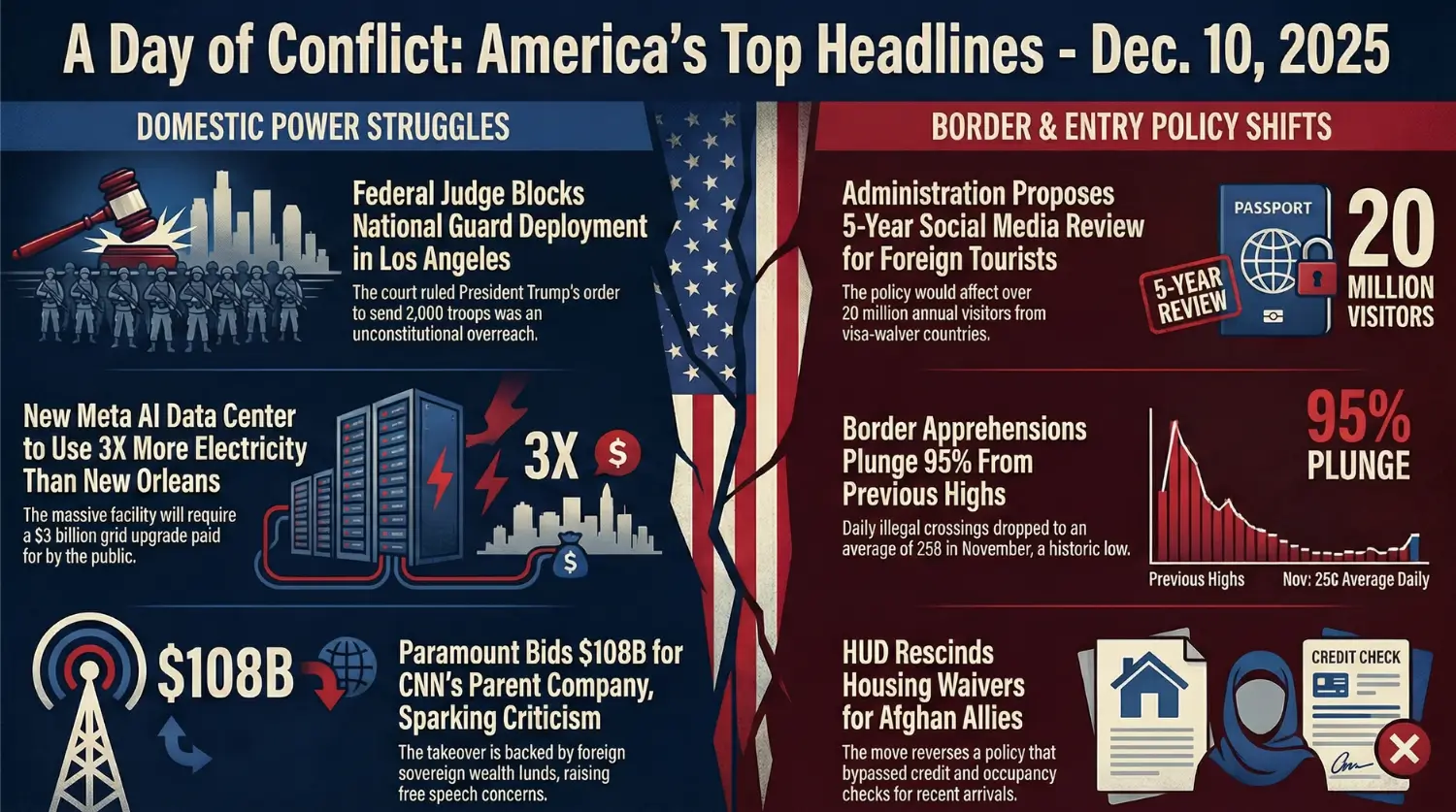
Senator Bernie Sanders criticized Meta’s Louisiana data center for tripling New Orleans’ electricity use and raising utility bills. Elizabeth Warren slammed Trump’s efforts to dismantle the CFPB, which has returned $19.7 billion to consumers. Chuck Schumer accused Trump of ignoring economic struggles amid rising costs and homelessness.
A Clinton-appointed judge halted Trump’s National Guard deployment in Los Angeles over federal overreach. The Trump administration proposed five-year social media reviews for foreign tourists and seized a Venezuelan oil tanker under sanctions. House approved a $900 billion defense bill in bipartisan vote.
1. Sen. Bernie Sanders Blasts Zuckerberg’s Data Center for Tripling New Orleans’ Electricity Use
Senator Bernie Sanders has ignited a firestorm by accusing Meta CEO Mark Zuckerberg of saddling Louisiana families with soaring utility costs through a colossal new data center project.
The Vermont independent, known for his populist critiques of corporate power, took to social media to decry the facility’s voracious energy appetite and the broader toll on everyday consumers.
Data centers like the one Meta is erecting in rural Richland Parish represent the backbone of modern artificial intelligence operations, housing vast server farms that process immense volumes of computations around the clock. These installations have proliferated amid the AI surge, drawing tech giants to regions with cheap land and lax regulations, but they often strain local infrastructure in ways that ripple through communities.
Louisiana, eager to lure such investments, reportedly offered Meta a $10 billion package of tax breaks and incentives to build what will become the company’s largest such site yet. Officials tout the project as an economic boon, projecting thousands of construction jobs and long-term tech employment, yet critics argue it prioritizes elite profits over sustainable growth in a state already grappling with energy poverty.
The facility’s power demands alone underscore these tensions, as it is set to draw roughly three times the annual electricity consumed by the entire city of New Orleans, according to utility filings and environmental analyses. This scale necessitates a $3 billion grid upgrade by Entergy Louisiana, complete with new gas-fired plants, raising alarms about fossil fuel reliance in a hurricane-prone area vulnerable to blackouts.
Sanders’ assertion that the data center will use three times more electricity than New Orleans holds up, with regulatory documents confirming the site’s projected 2 gigawatts of peak demand far exceeds the city’s roughly 700 megawatts average. His charge that billionaires like Zuckerberg aim to offload costs onto the public through higher bills also aligns with projections from rate-watch groups, which forecast potential 5-10% hikes for residential users to cover the expansions.
That said, Meta maintains the project incorporates energy-efficient designs and renewable sourcing commitments, potentially mitigating some long-term burdens, though independent audits question the timeline for those offsets. While Sanders frames this as deliberate exploitation by “oligarchs,” state leaders counter that the incentives prevent the company from fleeing to less regulated overseas markets, preserving domestic jobs amid global competition.
2. Clinton-Appointed Judge Blocks President Trump’s National Guard Deployment in Los Angeles
A federal judge in San Francisco has swiftly halted President Donald Trump’s order to send California National Guard troops into Los Angeles, citing overreach of federal authority.
The ruling comes amid escalating street protests in the city, where demonstrators have clashed with local police over immigration enforcement policies.
These deployments trace back to Trump’s early second-term push to federalize state militias in Democratic strongholds facing unrest. California Governor Gavin Newsom, a vocal opponent, sued the administration last month, arguing the move violates the Posse Comitatus Act that limits military involvement in domestic law enforcement.
Los Angeles has seen weeks of tense rallies against federal raids on undocumented immigrants, with reports of property damage and arrests straining city resources. Trump administration officials claimed the Guard was needed to protect federal agents, but critics view it as a tactic to intimidate opponents in blue states.
The court’s decision orders the approximately 2,000 troops already mobilizing to return to state control by December 15, allowing time for an appeal. Legal experts note this echoes past clashes, like the 2020 Portland protests, where similar federal interventions drew widespread condemnation.
It is true that Judge Charles Breyer, appointed by President Bill Clinton, issued the injunction on Wednesday, declaring the deployment unconstitutional without gubernatorial consent. Trump’s claim of an “invasion” at the border to justify the action lacks specific evidence tied to Los Angeles events, though broader migration pressures remain a flashpoint in national debates.
While the ruling underscores limits on executive power, it overlooks the administration’s reports of coordinated disruptions by activist groups, which some see as downplaying security threats for political gain. Breyer’s opinion emphasizes checks and balances, yet the delay until mid-December gives federal lawyers a window to argue emergency needs in higher courts.
3. Trump Administration Proposes Five-Year Social Media Review for Foreign Tourists Entering U.S.
The Trump administration is pushing a sweeping policy that would force millions of foreign visitors to surrender their social media details spanning five years just to step foot on American soil.
This move targets tourists from visa-waiver countries, aiming to tighten entry screens amid heightened national security concerns.
The visa-waiver program lets citizens from 41 nations skip traditional visas for short stays, relying instead on the Electronic System for Travel Authorization, or ESTA, a quick online check. Over 20 million travelers use this route yearly, fueling tourism dollars but sparking debates over vetting gaps that could let in threats.
Back in Trump’s first term, similar rules rolled out for visa applicants, requiring social media handles to flag risks like extremism, but enforcement stayed spotty due to tech hurdles. Now, with border tensions rising, officials want to expand it to ESTA users, blending phone numbers, emails, and online footprints into a deeper profile before approval.
Proponents argue this weeds out bad actors early, protecting communities from potential harm without blanket bans. Detractors worry it chills global travel, burdens families and businesses, and risks data misuse in an era of cyber breaches.
It is true that U.S. Customs and Border Protection filed the proposal last week, mandating social media identifiers from the past five years for ESTA applicants, as confirmed in federal notices. While the plan builds on prior policies, it broadens scope to non-visa tourists, potentially affecting allies like the UK and Japan, though full rollout hinges on public comments and tech upgrades.
Critics note the administration frames this solely as security, yet past implementations showed low denial rates from social scans, suggesting overreach for minor gains. Still, backers point to real cases of flagged threats, underscoring the trade-off between openness and caution in a wired world.
4. Senator Elizabeth Warren Slams Trump for Gutting CFPB’s $21 Billion Consumer Safeguards
Senator Elizabeth Warren has fired a sharp warning that President Donald Trump seeks to dismantle the Consumer Financial Protection Bureau, stripping away billions in relief for everyday Americans fleeced by financial giants.
The Massachusetts Democrat rallied with Senate Banking Committee colleagues to spotlight the agency’s vital role and the fallout from its potential demise.
The CFPB emerged from the ashes of the 2008 financial crash as a watchdog agency designed to shield families from predatory lending and deceptive practices by banks and credit firms. It handles complaints, probes abuses, and claws back funds through enforcement, turning the tide for victims of everything from junk fees to scam loans.
Over the years, the bureau has built a track record of direct action, issuing rules on fair credit reporting and cracking down on illegal debt collection tactics that prey on vulnerable households. Lawmakers who crafted it envisioned a standalone entity funded outside congressional whims to avoid industry capture, yet that independence now fuels the fight over its future.
Trump’s team has long viewed the CFPB as regulatory overreach, with early moves to install loyalists and slash its budget during his first term. Recent steps include halting new probes and redirecting cases to the Justice Department, moves that reportedly signal a wind-down amid funding disputes tied to its unique Federal Reserve draw.
It is true that the CFPB has delivered $19.7 billion in redress to 195 million consumers since 2011, through settlements and refunds from violators like major banks, though Warren’s cited figure of $21 billion appears slightly overstated based on the latest available data. Warren’s claim that Trump sides with scammers captures the partisan divide, as administration filings declare the agency’s funding model unconstitutional, though federal courts have repeatedly upheld it against such challenges.
That said, supporters of the cuts argue the bureau duplicates other regulators and stifles innovation, a view that overlooks data showing its actions boost competition by leveling the field against bad actors. The push also ignores ongoing lawsuits from employees and Democrats seeking to block the shutdown, highlighting how political agendas can eclipse proven consumer gains.
5. President Trump Deems Reports on His Health Treasonous in Outraged Response
President Donald Trump fired back at media outlets questioning his stamina during a recent rally. He called such coverage seditious and potentially treasonous, insisting the claims harm national security.
The 79-year-old leader made the remarks Tuesday after wrapping up a 90-minute speech in Pennsylvania. Attendees described his energy as robust, countering whispers about fatigue from a demanding schedule.
Reports surfaced earlier this week from investigations into Trump’s physical condition. Observers noted fewer public events and occasional lapses in focus, fueling debates over leadership fitness at his age.
These concerns stem from broader scrutiny of aging politicians in high-stakes roles. Medical experts stress routine checkups can address public doubts without invasive probes, yet Trump’s team dismisses them as partisan attacks.
Trump’s history includes touting perfect health scores from past exams. He often credits golf and fast food for keeping him sharp, brushing off critics as motivated by political grudges.
It is true that Trump uttered the treasonous label in direct response to a New York Times piece highlighting fatigue signs. The article drew on anonymous sources close to his inner circle, but White House physicians reaffirmed his bill of health last month with no red flags noted.
While Trump’s phrasing escalates typical pushback, legal scholars note treason requires aiding enemies, not just unfavorable press. This rhetoric aligns with his pattern of labeling opponents as disloyal, though no formal charges against journalists have followed similar outbursts.
6. Senate Leader Schumer Accuses Trump of Ignoring Americans Struggles from Billionaire Bubble
Senate Minority Leader Chuck Schumer sharply criticized President Donald Trump for failing to address everyday economic hardships in his latest public address. He portrayed the president as detached and out of touch with working families facing rising costs.
The remarks came hours after Trump wrapped up an event in Pennsylvania focused on economic policy. Schumer highlighted how the speech overlooked core issues like inflation and affordability that dominate household budgets.
Trump’s appearance at the Mount Airy Casino Resort drew crowds eager for updates on job growth and trade deals. Yet observers noted the discussion veered into personal attacks on political rivals and complaints about immigration enforcement.
These patterns reflect ongoing tensions in Washington over fiscal priorities nearly a year into Trump’s second term. Lawmakers from both parties grapple with stalled bills aimed at easing consumer burdens, while public approval ratings hover amid persistent price hikes.
Schumer, as head of Senate Democrats, often uses floor speeches to counter administration narratives on prosperity. His comments underscore a broader divide, where Republicans emphasize deregulation benefits and Democrats push for targeted relief measures.
It is true that Trump’s Pennsylvania address spent limited time on direct solutions for inflation, instead featuring unsubstantiated assertions that prices had fallen sharply. Economic data from recent months shows consumer costs up by over three percent year-over-year, contradicting those statements and fueling partisan debates.
Schumer’s portrayal of Trump as bubble-bound carries a rhetorical edge, though it aligns with critiques from across the aisle about elite influences in policy-making. No evidence suggests deliberate omission of struggle topics, but the speech’s shift to grievances has drawn widespread analysis for missing opportunities to connect with voters.
7. Senator Blackburn Accuses Meta of $20 Million Lobby Push to Kill Kids Online Safety Act
Senator Marsha Blackburn charged that Meta poured $20 million into efforts to derail her Kids Online Safety Act this year. She argued the company fears mandates for built-in protections that shield children from online harms.
The Tennessee Republican made the allegation during a recent Senate floor statement. Her bill seeks to hold tech giants accountable for platform designs that prioritize youth well-being over unchecked engagement.
Lawmakers introduced the Kids Online Safety Act in prior sessions to tackle rising concerns over social media’s impact on minors. Proponents highlight data showing increased anxiety and exposure to predators among teens glued to apps for hours daily.
Opponents counter that such rules could stifle innovation and free speech on digital spaces. Federal regulators have ramped up scrutiny since 2023, with fines hitting platforms for lax age verification and content moderation.
Blackburn’s push aligns with bipartisan calls for reform amid parent-led campaigns. Yet progress stalls in divided committees, where industry voices weigh heavy against consumer advocates.
It is true that Meta reported nearly $20 million in total federal lobbying expenditures through late October 2025. However, disclosures show only a fraction, around $6 million in the third quarter alone, targeted child safety measures like the Kids Online Safety Act, with the rest covering broader issues such as antitrust and AI rules.
Blackburn’s claim ties the full amount directly to blocking her bill, which overstates the specific allocation per public filings. This framing amplifies political pressure on tech firms but omits how lobbying often bundles multiple policy fights into one budget.
8. Senator Adam Schiff Hails Federal Judge’s Order to End Trump’s “Misuse” of National Guard in Los Angeles
A federal judge reportedly ruled that President Donald Trump’s ongoing deployment of California National Guard troops in Los Angeles violates federal law, prompting Senator Adam Schiff to demand their immediate withdrawal.
The decision comes after months of legal challenges from state officials, who argued the roughly 100 remaining service members served no legitimate purpose following the initial emergency justification.
The deployment began in June 2025, when Trump invoked emergency powers to station thousands of Guard troops along California’s borders and urban centers. Officials cited rising illegal border crossings and localized unrest as reasons for the move, aiming to bolster federal immigration enforcement amid strained resources. California Governor Gavin Newsom quickly contested the federalization of state troops, claiming it stripped local control without congressional approval and diverted personnel from wildfire response and disaster aid.
Over the summer, the Guard’s role shifted from patrols to support operations, but critics pointed to idle units stationed in parking lots and warehouses as evidence of inefficiency. Taxpayer costs reportedly topped $150 million by fall, fueling bipartisan grumbles over diverted funds that could address infrastructure gaps or veteran programs. Legal filings highlighted instances where troops clashed with protesters during routine checks, raising concerns about escalation in diverse communities.
Reports indicate the judge’s order, issued by U.S. District Judge Charles Breyer, stems from a lawsuit filed by California’s attorney general alleging overreach under the Posse Comitatus Act. Breyer reportedly described the continued presence as a “profoundly un-American” extension of executive power, effective December 15 unless appealed. This ruling aligns with prior court rebukes of similar federal-state troop disputes, though the White House has signaled plans to challenge it swiftly.
It is true that the judge ordered the deployment’s end, confirming Schiff’s statement on the troops’ return, though the administration disputes the “misuse” label and vows an appeal. Claims of abuse and waste hold merit based on documented costs and idle periods, but supporters argue the Guard deterred crossings effectively before the ruling. The partisan framing overlooks how initial deployments received mixed reviews from border security advocates, who noted temporary drops in encounters.
9. Senator Mark Kelly Defies President’s Threats with Pledge to “Stick Up for the American People” Every Day
Senator Mark Kelly, the Arizona Democrat and retired Navy captain, reportedly issued a firm statement amid escalating tensions with the White House, refusing to back down from his duties.
His words come after the Trump administration allegedly launched probes into Kelly’s recent public call for military personnel to uphold the Constitution over unlawful directives.
The controversy traces back to a November video where Kelly, alongside other veterans in Congress, urged service members to prioritize legal oaths during potential crises. That message, intended as a reminder of military ethics, quickly drew fire from President Trump, who labeled it seditious and suggested severe penalties for those involved. Federal officials soon followed with announcements of investigations, including threats to recall Kelly to active duty for potential court-martial over his comments.
By late November, the Pentagon reportedly ordered a review of Kelly’s conduct, citing risks to unit cohesion from his statements. Critics within the administration argued the video undermined chain-of-command loyalty, while supporters viewed it as standard civic guidance for troops facing ethical dilemmas. This clash highlights broader frictions between congressional oversight and executive control of the armed forces, especially as budget fights and deployment debates intensify.
Reports indicate the Navy Secretary received letters from Democratic senators demanding the probe’s halt, calling it a blatant misuse of military authority against elected officials. Kelly’s background as a combat pilot and astronaut adds weight to his stance, positioning him as a voice for principled service amid partisan divides. Such episodes raise questions about how far political retribution can extend without eroding public trust in institutions.
It is true that the president and his allies have issued threats against Kelly, including calls for prosecution tied to the video, though no formal charges have materialized as of December 10. Kelly’s claim of ongoing intimidation aligns with documented statements from Trump and Pentagon memos, but the administration counters that these are lawful inquiries into potential breaches, not personal vendettas. The partisan lens in Kelly’s response omits how some military experts praised the video’s intent while noting its timing fueled unnecessary alarm.
10. HUD Secretary Scott Turner Rips Biden’s “Special Privilege” for Unvetted Afghans in Rental Rules
HUD Secretary Scott Turner reportedly blasted a prior policy from the Biden administration that allegedly granted housing breaks to Afghan arrivals without standard vetting.
His department just pulled the guidance, aiming to level the playing field for all renters under federal fair housing standards.
The policy stemmed from the chaotic 2021 U.S. pullout from Afghanistan, when over 76,000 Afghans landed parole status and needed quick shelter. Federal agencies rolled out Operation Allies Welcome to speed up aid, including tips for landlords on bending rules like skipping background reviews or cramming more people into units. This setup helped place families fast but sparked gripes from housing experts about uneven treatment compared to other newcomers or locals scraping by.
By mid-2022, reports showed the waivers covered nearly 200,000 eligible Afghans, with costs hitting public programs hard amid a rental crunch. Landlords got memos urging flexibility on occupancy caps, which normally cap units by family size to avoid overcrowding hazards. Critics then and now argue those tweaks sidestepped civil rights protections, potentially boxing out American families from tight markets.
Turner, a former NFL player turned housing chief, tied the rollback to wider immigration strains on inventory. His team claims the old rules fueled resentment by prioritizing one group, while data links border surges to rent hikes in key cities. This shift fits Trump’s push to tighten federal aid for non-citizens, redirecting focus to citizens first.
It is true that the Biden guidance encouraged forgoing credit checks and occupancy limits for Afghan parolees, as outlined in 2021 memos to ease their integration. The rescission by HUD restores those enforcement tools without exemptions, though advocates warn it could slow housing access for vulnerable allies who aided U.S. forces. Turner’s portrayal as “special privilege” for “unvetted” arrivals carries a partisan edge, since parolees underwent security screenings, but it overlooks how the policy aimed at humanitarian urgency rather than favoritism.
11. Rep. Chip Roy Urges Congress to Lock in Trump’s Border Wins as Apprehensions Plunge 95%
Rep. Chip Roy of Texas reportedly praised recent border enforcement gains under President Trump, pushing lawmakers to enact permanent measures.
Border Patrol Chief Michael Banks highlighted November’s sharp decline in illegal crossings, with daily averages dropping 95% from earlier highs.
Trump’s team ramped up patrols and barriers after taking office, building on wall segments and swift deportations to deter entries. These steps followed years of record surges, where agents handled over 2 million encounters annually under prior rules that allowed releases into the interior. Local ranchers along the Rio Grande now report quieter nights, with fewer groups testing weak spots in remote sectors.
Federal data tracks how expanded agent training and tech like sensors cut processing times, freeing personnel for proactive sweeps. Community programs pair enforcement with tips on legal work visas, aiming to channel flows through ports rather than deserts. Yet strains persist on shelters near crossings, where families wait out claims amid backlogs.
Such trends boost morale among guardsmen, who credit policy consistency for safer shifts without overtime crunches. Critics note weather plays a role in seasonal dips, but officials point to sustained lows over months as proof of strategy. This momentum pressures holdouts in Congress to debate codification before midterms shift seats.
It is true that southwest border apprehensions averaged 258 per day in November 2025, marking a 95% drop from Biden administration peaks around 5,000 daily. Banks’s report aligns with Customs and Border Protection tallies, though the figure compares to 2021-2024 highs rather than Trump’s first term. Roy’s framing as wholly “successful” policies skips how bipartisan funding helped scale operations, including Democratic-backed tech upgrades.
12. Senator Bernie Sanders Slams Trump’s ‘A+++++ Economy’ Boast: ‘God Help Us If We Get to a B or a C’
President Donald Trump recently touted the U.S. economy as performing at an “A+++++” level during a rally in Pennsylvania. Senator Bernie Sanders quickly fired back with sharp sarcasm, highlighting how everyday Americans face mounting financial pressures despite official growth figures.
Sanders, the independent senator from Vermont, made his pointed remark on social media shortly after Trump’s comments aired on cable news. The exchange underscores a growing partisan divide over economic health, with Trump emphasizing stock market gains and job creation while critics focus on household budgets strained by high costs.
Trump’s statement came amid a series of events where he addressed affordability concerns head-on, calling complaints about prices a “hoax” tied to immigration. Reports indicate he traveled from Joint Base Andrews to a Pennsylvania town hall on December 9, 2025, to deliver the upbeat assessment directly to supporters. This approach mirrors tactics used in past campaigns, aiming to counter public skepticism with bold optimism.
The broader economic picture reveals a mixed bag of indicators as 2025 draws to a close. Gross domestic product expanded at a robust 3.8% annualized rate in the second quarter, outpacing many global peers and signaling strong overall activity. Yet consumer prices for essentials like food remain elevated, with surveys showing about 60% of households living paycheck to paycheck.
Unemployment stands at 4.4%, a figure that reflects steady labor market resilience but also hints at softening demand in some sectors. Homelessness has climbed to around 800,000 individuals nationwide, per recent tallies, while wage growth trails inflation in real terms for many workers. These trends fuel debates on whether headline numbers truly capture the lived experience of average families.
It is accurate that Trump described the economy in superlative terms during his recent speech, aligning with his pattern of high praise for policy outcomes. Data from the Bureau of Economic Analysis confirms the solid GDP uptick, and stock indexes like the S&P 500 have risen over 13% since his inauguration. However, economist critiques, including from Nobel laureate Paul Krugman, note that public perceptions lag due to persistent affordability gaps, with polls showing most Americans rating the economy closer to a C grade.
Sanders’ retort draws from verified stats on income inequality and cost burdens, though his phrasing amplifies the partisan lens by implying total failure under current leadership. Trump’s team points to tariff policies and tech booms as drivers of progress, but independent forecasts from groups like the OECD project slower growth at 2% for the full year. This contrast highlights how both sides selectively frame the same data to suit their narratives, without altering the underlying facts.
13. Secretary Doug Burgum Hails $280 Million Gulf Lease Sale as ‘Major Milestone’ in American Energy Dominance
Interior Secretary Doug Burgum reportedly praised the latest oil and gas auction in the Gulf of Mexico, where bids topped nearly $280 million from major energy firms.
House Majority Leader Steve Scalise also celebrated the event as the first under the Working Families Tax Cut, tying it to broader goals for jobs and security.
This sale marks a shift in federal energy strategy, with the Trump administration pushing to expand offshore drilling after years of tighter controls.
The Working Families Tax Cut, signed earlier this year, mandates up to 30 such auctions to boost production and fund coastal defenses.
Proponents argue these moves counter past restrictions that slowed output and raised costs for consumers.
Energy companies like Chevron and Shell reportedly submitted strong bids, signaling confidence in future yields from the region’s vast reserves.
Louisiana leaders highlight how proceeds will support barrier island projects against storm surges.
Such funds have already restored thousands of acres of wetlands hit by prior hurricanes.
It is true that the auction drew about $280 million in winning bids, the highest for a Gulf sale in recent years.
Records confirm strong participation from at least a dozen firms, despite earlier regulatory hurdles under the prior administration.
Provisions in the tax cut law direct a portion of revenues toward Gulf state restoration, with Louisiana set to receive millions for flood barriers.
Critics note the sale overlooks updated climate risks, though backers point to economic gains without immediate environmental breaches.
14. Federal Judges Approve Release of Redacted Epstein Grand Jury Files After Landmark Legislation
The Epstein Files Transparency Act, signed into law last month, mandates the Department of Justice to disclose unclassified records from investigations into Jeffrey Epstein’s s-x trafficking network by mid-December. This bipartisan measure, co-sponsored by lawmakers across the aisle, aims to shed light on the disgraced financier’s operations while safeguarding victim identities through careful redactions. Previously sealed materials, including transcripts and evidence summaries, could reveal more about Epstein’s enablers and the scope of his crimes that ensnared dozens of minors.
It is true that three federal judges, who earlier denied unsealing requests due to longstanding grand jury secrecy rules, have now determined the new law overrides those restrictions, paving the way for the materials’ release with appropriate protections. This shift addresses prior blocks by judges appointed during Democratic administrations, ensuring the process aligns with both transparency goals and privacy safeguards. While the Act focuses on non-classified documents, it does not compel disclosure of sensitive victim details or unrelated personal information.
15. Tucker Carlson Revives Candace Owens’ Conspiracy Claims on Egyptian Surveillance of Kirk’s Widow
The assassination of conservative firebrand Charlie Kirk in September sent shockwaves through political circles, prompting wild speculation about hidden hands at play. His death, ruled a targeted shooting outside a Turning Point USA event in Utah, left allies grappling for answers amid a backdrop of internal feuds over foreign policy stances.
Reportedly, Kirk’s wife, Erika, had grown uneasy about perceived threats in the months leading up to the incident, including whispers of international intrigue that Owens later amplified on her platform. These narratives gained traction among certain conservative audiences, blending grief with demands for deeper probes into possible external actors.
Such theories have divided the right, with some dismissing them as distractions from domestic radicalism, while others rally behind calls for transparency. The Kirk case highlights ongoing rifts, from donor pullouts over Israel policy shifts to leaked messages revealing private doubts.
Investigators have found no evidence supporting foreign aerial tracking of Erika Kirk or an influx of overseas devices at the shooting site, attributing the killing instead to a lone domestic perpetrator with ideological grudges. Carlson’s recent remarks, while acknowledging the claims’ supposed validity without explanation, align with a pattern of unverified assertions that experts label as speculative at best.
16. Trump Administration Reportedly Sues Georgia for Refusing to Turn Over Voter Rolls
The Trump administration’s Department of Justice has intensified efforts to access state voter registration data, citing federal laws aimed at maintaining accurate rolls and preventing fraud. This latest action against Georgia follows similar lawsuits against more than a dozen other states, part of a broader push to verify voter eligibility amid ongoing debates over election integrity.
While the administration claims Georgia’s refusal violates the National Voter Registration Act, records show no such lawsuit has been filed specifically against the Peach State as of early December 2025. Instead, the DOJ has targeted states like California, Michigan, and recently Delaware and Washington, alleging noncompliance with data-sharing requirements. It is true that Georgia has faced separate scrutiny over its election processes, including challenges to ballot designs, but the reported suit appears unsubstantiated based on public filings.
17. Illinois Governor Signs Bill Blocking ICE Arrests of Illegal Aliens Near Courthouses
Governor JB Pritzker of Illinois recently approved legislation aimed at limiting federal immigration enforcement in sensitive public spaces, a direct response to heightened ICE operations under the Trump administration. The measure, known as House Bill 1312, bars agents from detaining individuals within 250 feet of courthouses, hospitals, and schools, seeking to ensure access to justice without fear of deportation. This comes after federal raids in Chicago netted hundreds of arrests, sparking local outcry over aggressive tactics.
The claim holds up, as official records confirm Pritzker signed the bill on December 9, 2025, explicitly prohibiting such arrests to protect community trust in legal proceedings. While critics argue it hampers national security efforts, the law aligns with existing state sanctuary policies and faces no immediate legal challenges.
18. U.S. House Approves Sweeping $900 Billion Defense Spending Bill in Bipartisan Vote
Lawmakers in the U.S. House of Representatives delivered a decisive approval for the National Defense Authorization Act, unlocking $900 billion to fortify military readiness, upgrade weapons systems, and raise troop salaries by 4.2 percent. This annual must-pass measure sets the stage for enhanced national security investments as geopolitical pressures mount from regions like the Indo-Pacific and Eastern Europe.
The legislation indeed authorizes roughly $900 billion in discretionary defense spending for fiscal year 2026, exceeding the Pentagon’s initial request by about $8 billion, and it passed with overwhelming support from both parties, confirming the stories core details without exaggeration.
19. Senator Elizabeth Warren Labels Paramount’s Warner Bros. Bid “Corruption in Service of Squashing Free Speech”
Senator Elizabeth Warren sharply criticized a recent corporate maneuver reportedly aimed at gaining influence over a major news network. The Massachusetts Democrat highlighted how President Trump’s longtime push against CNN now intersects with a high-stakes media merger that could reshape broadcasting landscapes.
The controversy centers on Paramount’s aggressive $108 billion hostile takeover offer for Warner Bros. Discovery, the parent company of CNN, HBO, and other assets. Reportedly unveiled just days after a competing Netflix proposal, the bid promises shareholders $30 per share and full control over Warner’s portfolio, including its linear TV channels that have struggled amid streaming shifts. Backers include Jared Kushner’s Affinity Partners and sovereign wealth funds from Saudi Arabia, Qatar, and Abu Dhabi, raising eyebrows over foreign sway in American media.
It is true that the Paramount offer encompasses CNN, as Warner Bros. Discovery owns the network outright, and financing details confirm involvement from Kushner’s firm alongside Gulf state investors. President Trump has indeed advocated for CNN’s separate sale in any deal, stating it should be “guaranteed and certain that CNN is part of it or sold separately,” while decrying its current leadership as a “disgrace.” Warren’s assertion of Trump’s historical efforts to curb CNN aligns with his repeated public attacks on the outlet over coverage disputes.
20. Venezuela Accuses US of Oil Tanker Seizure as ‘Robbery and Piracy’
The United States reportedly seized a Venezuelan oil tanker loaded with heavy crude off the country’s coast on Wednesday, as part of ongoing efforts to enforce sanctions against President Nicolas Maduro’s regime. This move, announced by President Donald Trump during a meeting with business leaders, represents a notable escalation in the longstanding tensions between Washington and Caracas over economic and political issues.
It is true that the vessel was under US sanctions, providing a legal rationale for the seizure under international penalties targeting illicit activities. Venezuela’s official response accurately describes the action as “blatant theft and an act of international piracy,” consistent with their criticism of US foreign policy, though the sanctioned status of the tanker supports the operation’s validity.