Follow TNGB
Hidden Headlines Daily Recap – December 8, 2025

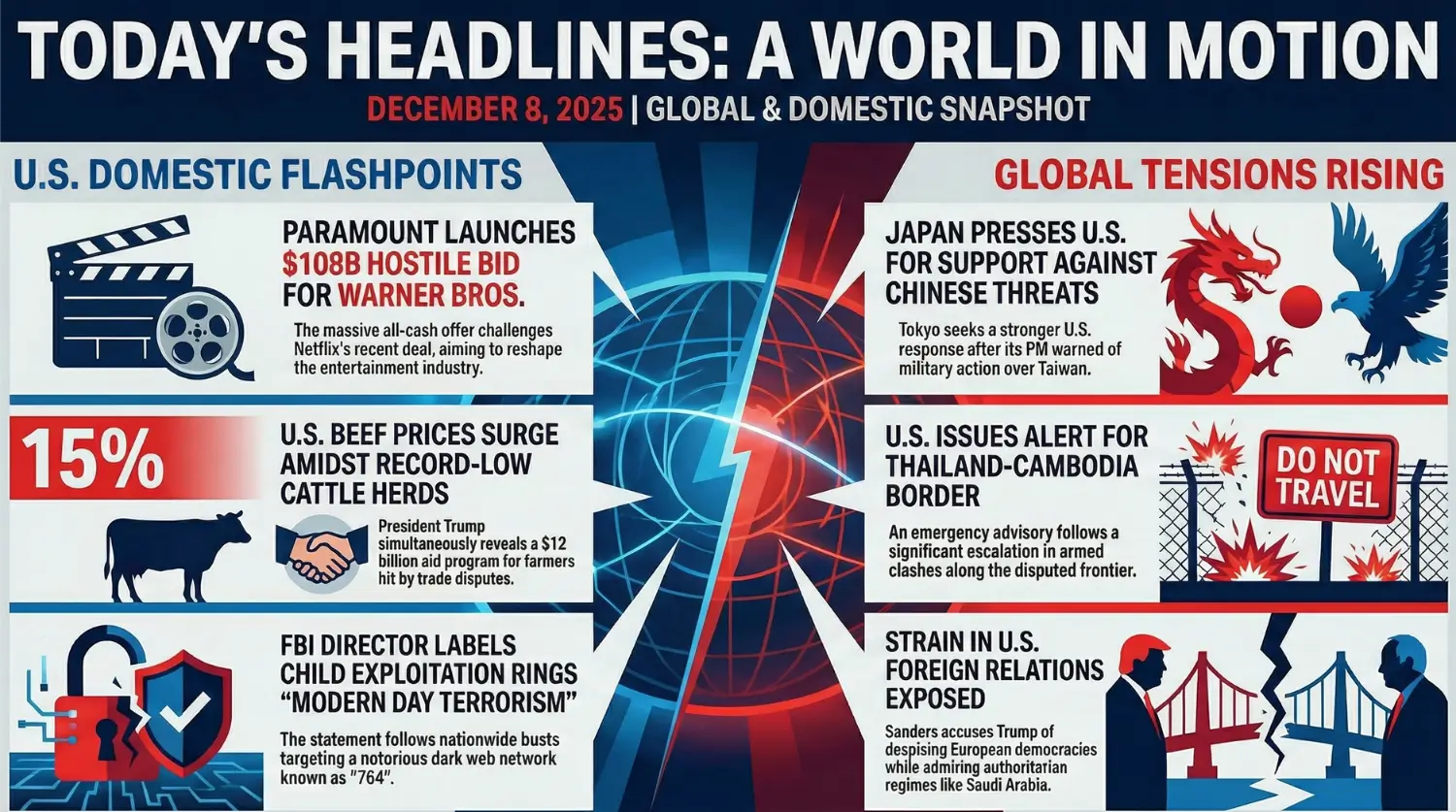
On December 8, 2025, U.S. politics heated up with Bernie Sanders criticizing Trump’s foreign policy favoritism toward Saudi Arabia over Europe’s social systems, while scrutiny grew over Rep. Ilhan Omar’s ties to a $250 million Minnesota fraud. Internationally, Japan urged stronger U.S. support against Chinese threats near Taiwan, and a U.S. travel ban was issued for the Thailand-Cambodia border amid escalating clashes.
Economic news featured Trump’s $12 billion farmer aid package to offset trade war losses, canceled BLS data releases due to funding issues, and surging U.S. beef prices from low cattle herds. Social highlights included FBI busts on child exploitation rings, a push for WWII nurse veteran recognition, and a Gallup poll showing U.S. alcohol consumption at its lowest since 1939.
1. Senator Bernie Sanders Accuses Trump of Hating Europe’s Democracies for Their Universal Health Care
Vermont Senator Bernie Sanders sharply criticized President Donald Trump for reportedly despising European nations due to their social safety nets and strong labor protections. He contrasted this with Trump’s alleged admiration for Saudi Crown Prince Mohammed bin Salman’s authoritarian rule.
Sanders highlighted how Trump’s policies favor absolute monarchies over allied democracies that prioritize worker rights and public health access. The senator’s remarks come amid ongoing tensions in U.S. foreign relations.
Trump has repeatedly targeted Europe with trade barriers, including a 20% tariff on EU imports announced earlier this year to address what he calls unfair economic advantages from their welfare models. These measures have strained transatlantic ties, with European leaders pushing back against what they see as protectionist overreach.
On the Saudi front, Trump hosted bin Salman at the White House in November, signing a major defense pact and announcing billions in investments that bolster the kingdom’s military edge. This warming relationship overlooks documented human rights concerns, including the crown prince’s role in past crackdowns on dissent.
It is accurate that Trump has voiced frustration with Europe’s universal health systems, blaming them for driving up U.S. drug prices through aggressive negotiations with pharmaceutical firms. His administration’s recent strategy document also warns of Europe’s potential “civilizational erasure” from demographic shifts, aligning with Sanders’ portrayal of disdain for their progressive policies.
Trump’s deepened Saudi ties, including overlooking intelligence on bin Salman’s involvement in the 2018 Khashoggi killing, do reflect a preference for strategic partnerships over democratic alignments, though White House officials frame it as pragmatic energy security. Sanders’ “betrayal of American values” charge captures a partisan divide, as Republicans emphasize economic gains from the alliance while downplaying governance differences.
2. Paramount Unveils $108 Billion Hostile Bid to Snatch Warner Bros. from Netflix’s Grasp
Paramount reportedly fired back at Netflix with a massive all-cash offer for Warner Bros. Discovery, aiming to buy the entire company outright. This aggressive move challenges the streaming giant’s recent agreement and could reshape Hollywood’s power dynamics.
The bid values Warner Bros. Discovery at about $30 per share, topping Netflix’s proposal by billions in potential shareholder payouts. Industry watchers see this as a high-stakes clash between old-school studios and digital disruptors.
Warner Bros. Discovery has faced tough times lately, with streaming losses and cord-cutting hitting cable revenues hard. The company planned to split its assets earlier this year, separating film studios from news and reality networks to attract buyers.
Netflix stepped in last week with a deal focused on Warner’s content powerhouse, including HBO and blockbuster franchises. That pact requires the split to happen first, leaving cable channels like CNN on their own amid declining ad dollars.
Paramount’s full-company play avoids that breakup, promising quicker closure and fewer regulatory snags for investors. Backed by deep-pocketed backers, the offer targets shareholders directly to bypass board resistance.
It is true that Paramount’s hostile tender stands at roughly $108 billion in enterprise value, outpacing Netflix’s $72 billion equity commitment for key assets. While Netflix’s mix of cash and stock introduces market volatility, Paramount’s all-cash structure offers more certainty, though antitrust reviews could drag both deals into prolonged scrutiny.
The story overlooks Warner Bros. Discovery’s planned asset separation, which structures Netflix’s bid around studios only, not the whole firm. This partisan framing by deal boosters downplays how cable remnants might fetch lower standalone values, tilting perceptions toward a straight bidding war narrative.
3. U.S. State Department Urges Americans to Avoid All Travel Near Thailand-Cambodia Border Over Sharp Conflict Rise
The U.S. State Department has issued a stark emergency advisory, telling citizens to steer clear of any trips within 50 kilometers of the Thailand-Cambodia border. Officials cite a significant escalation in the conflict there, with reports of armed clashes prompting fears for traveler safety.
This warning comes amid fresh tensions that have simmered for months between the neighboring nations. Both sides claim historical rights to disputed territories, leading to sporadic military buildups and occasional firefights along the frontier.
The border area in question stretches over rugged terrain near ancient temples like Preah Vihear, a UNESCO site long at the heart of sovereignty spats. Thailand and Cambodia have traded accusations of incursions, with each deploying troops and artillery in response to perceived threats from the other.
Local communities on both sides face disruptions, including school closures and restricted movement as forces dig in. International mediators have called for calm, but progress remains elusive despite past diplomatic efforts to demarcate the line.
It is true that the State Department updated its advisory to a Level 4 “Do Not Travel” status for that zone, aligning with reports of intensified skirmishes on December 8, 2025. While the exact trigger for this week’s surge stays unclear, independent monitors confirm heightened military activity without evidence of broader invasion plans by either party.
4. Bureau of Labor Statistics Cancels Vital October Producer Price Index Release Over Data Shortfall
The Bureau of Labor Statistics announced it will skip the October Producer Price Index report entirely. This decision leaves economists and investors without a key gauge of wholesale inflation trends for that month.
The move stems from a recent lapse in federal funding that halted routine data gathering. Officials noted the absence of essential surveys made accurate compilation impossible despite efforts to catch up.
Producer prices track changes in costs for goods and services at early production stages. These figures help the Federal Reserve assess inflationary pressures before they reach consumers through retail sales.
The index often signals broader economic shifts like supply chain strains or commodity spikes. Without October’s snapshot investors face gaps in forecasting tools amid ongoing recovery debates.
Reports confirm the cancellation aligns with broader impacts from the funding disruption. Similar holds affected other releases including real earnings data yet core metrics like September’s PPI emerged intact after delays.
5. FBI Director Kash Patel Labels Child Exploitation Rings “Modern Day Terrorism” After Latest Nationwide Busts
Federal authorities reportedly announced fresh arrests tied to a notorious online child exploitation network, underscoring ongoing threats to vulnerable youth across the U.S.
Director Patel highlighted the operation’s severity, vowing relentless pursuit of those involved in producing illicit materials and coordinating abuse.
The 764 network emerged around 2022 as a dark web collective, allegedly using encrypted apps to groom and blackmail minors into creating explicit content.
Members reportedly coerce victims with threats of violence, including self-harm or harm to pets, while sharing materials for profit or notoriety within extremist circles.
This group blends cyberstalking with ideological extremism, drawing in isolated teens through gaming platforms before escalating to exploitation.
Law enforcement has traced connections to over a dozen countries, with U.S. cases often involving interstate coordination that evades local patrols.
It is true that federal indictments unsealed last week charged five men in five states with running a child exploitation enterprise and producing child p–nography, aligning with Patel’s update on 764-related actions.
These charges carry potential life sentences and stem from coordinated probes under Project Safe Childhood, a bipartisan initiative since 2006 aimed at online predators.
While Patel’s “terrorism” framing amplifies the issue’s urgency, experts note it fits federal patterns for designating networks that incite widespread harm, though some civil groups caution against over-militarizing child protection efforts.
6. Scrutiny Mounts Over Rep. Ilhan Omar’s Links to Massive $250 Million Minnesota Fraud Scheme
Federal investigators have uncovered a sprawling COVID-era meal program scam in Minnesota that allegedly siphoned $250 million in taxpayer funds through fake sites run by Somali-owned businesses.
Rep. Ilhan Omar, whose district includes many of those affected communities, now faces questions about her reported role in easing rules that prosecutors say opened the door to the abuse.
The Feeding Our Future nonprofit at the heart of the case submitted claims for meals that never happened, using over 200 sites to bill the government for nonexistent child feedings during pandemic school closures.
Prosecutors charged dozens in 2022, with convictions piling up as recently as August 2025, revealing a network that allegedly funneled cash to luxury purchases and overseas transfers.
Omar sponsored the 2020 MEALS Act to expand nutrition access for underserved kids, but critics argue it cut verification steps that might have caught the inflated claims early.
That bill passed amid urgent pandemic needs, yet ongoing trials show how lax federal oversight reportedly let fraudsters exploit the system for personal gain in immigrant-heavy areas like Minneapolis.
Reports confirm Omar’s legislation contributed to reduced paperwork for reimbursements, which prosecutors link to the scheme’s scale, though direct causation remains debated in court.
She also hosted her 2018 victory party at Safari Restaurant, owned by Salim Ahmed Said, who received a prison sentence in March 2023 for his part in the wire fraud conspiracy.
Additionally, Guhaad Hashi Said, a onetime aide in her office, pleaded guilty this year to related wire fraud and money laundering charges tied to the same operation.
While Omar faces no charges herself, these connections have drawn bipartisan calls for reviews of congressional influence on aid programs.
7. Japan Presses Trump to Back PM Takaichi’s Taiwan Warning as Chinese Threats Escalate
Japanese officials reportedly expressed deep frustration over President Trump’s administration’s subdued response to recent Chinese provocations against their nation.
They allegedly urged a stronger U.S. defense of Prime Minister Sanae Takaichi following her bold assertion that a potential Chinese assault on Taiwan might trigger a Japanese military reply if it endangers national security.
Takaichi’s comments came amid heightened tensions in the East China Sea, where Chinese vessels have repeatedly intruded into disputed waters near the Senkaku Islands, which Japan administers but Beijing claims as its own.
These incursions have reportedly intensified over the past month, with Chinese coast guard ships shadowing Japanese fishing boats and military aircraft buzzing close to Japanese airspace, prompting Tokyo to scramble defense forces multiple times weekly.
The prime minister’s statement aimed to signal Japan’s readiness to protect its interests under the U.S.-Japan security treaty, which obligates Washington to aid Tokyo against external aggression.
Yet Beijing reacted swiftly with outrage, issuing official condemnations and anonymous online death threats directed at Takaichi, labeling her remarks as provocative warmongering.
U.S. officials have so far limited their commentary to general calls for restraint from all parties, avoiding direct endorsement of Japan’s position or condemnation of China’s moves.
This perceived passivity from the Trump White House has fueled concerns in Tokyo that America might prioritize domestic priorities over longstanding Pacific alliances.
The facts align with reports from international observers, confirming Takaichi’s exact phrasing on a potential military response tied to Taiwan contingencies.
Chinese reprisals, including a formal UN complaint accusing Japan of aggression, match documented diplomatic exchanges, though the death threats remain unverified beyond social media claims.
Japan’s push for firmer U.S. support reflects accurate frustrations, as alliance commitments under the treaty have historically involved prompt statements during flare-ups.
8. AG Bondi Vows DOJ Will ‘FIGHT’ for Resigned NJ U.S. Attorney Alina Habba
Alina Habba, a longtime legal advisor to President Trump, has stepped down from her role as acting U.S. Attorney for New Jersey following months of courtroom disputes over her appointment.
Attorney General Pam Bondi quickly announced that the Justice Department plans to challenge the rulings further, with Habba slated to return if successful.
Habba took the interim position in March 2025, tasked with overseeing federal prosecutions in a state known for complex cases involving organized crime and public corruption.
Her tenure drew immediate scrutiny from federal judges who questioned the extension of her 120-day acting term under longstanding statutes that limit such appointments without Senate confirmation.
The Third Circuit Court of Appeals upheld a lower court’s decision last week, declaring her continued service unlawful and voiding actions taken after the initial period expired.
This ruling stemmed from a challenge by New Jersey’s district judges, who argued the Department of Justice bypassed proper procedures in keeping her on amid ongoing vacancies.
Reports indicate Habba’s office pursued high-profile cases against alleged illegal immigrants and local officials tied to election irregularities during her brief time in charge.
Critics within legal circles pointed to her lack of prior federal prosecutorial experience as a factor in the judicial pushback, though supporters hailed her aggressive approach to enforcement priorities.
It is accurate that Habba resigned on December 8, 2025, after the appeals court affirmed the disqualification, ending a legal standoff that began in July.
Bondi’s pledge to “fight” aligns with her public statements on social media, where she described the judges as politically motivated, though court records show the decisions rested on statutory interpretations rather than bias.
Habba’s shift to senior advisor for U.S. Attorneys within the DOJ appears confirmed by department announcements, allowing her to influence policy without direct prosecutorial duties.
The characterization of “activist judges” reflects a partisan view from administration allies, as the rulings cited specific federal vacancy laws without evidence of ideological overreach.
9. President Trump Reveals $12 Billion Aid Lifeline for Farmers Reeling from Trade Disputes
White House officials confirmed President Donald Trump will roll out a $12 billion assistance program targeting American farmers battered by escalating global trade tensions.
The move comes amid reports of sharp declines in crop exports, particularly soybeans, as retaliatory tariffs from key markets like China squeeze rural economies.
This aid initiative reportedly builds on earlier federal support measures, aiming to stabilize farm incomes through direct payments and market adjustments. Farmers in the Midwest have voiced relief over the funding, though some question its long-term fix for supply chain disruptions.
The package allocates roughly $11 billion in one-time crop subsidies, with the rest funneled into food purchases and export promotion efforts. Administration spokespeople stress the aid offsets losses from foreign barriers, not domestic policy shifts.
Reports indicate the tariffs, imposed to protect U.S. manufacturing, have indeed slashed farm revenues by billions since their rollout. It is true that soybean exports to China dropped over 70% in recent years, per agriculture department data, validating the need for intervention.
Critics from farm advocacy groups note the bailout does little to resolve underlying trade imbalances, potentially repeating cycles of dependency on government checks. Still, the figure aligns precisely with White House projections for immediate relief, without exaggeration.
10. Senator Elizabeth Warren: “It’s about time we recognize these women” for WWII Cadet Nurse Corps Service.
Nearly 120,000 women stepped up during World War II to fill critical gaps in the nation’s hospitals through the U.S. Cadet Nurse Corps. These recruits underwent rigorous training and provided essential care on the home front, freeing up male nurses for combat zones.
The program, launched in 1943, offered accelerated education in exchange for a commitment to serve until the war ended. Participants wore distinctive gray-and-white uniforms and handled everything from emergency triage to long-term patient recovery across civilian and military facilities.
Despite their sacrifices, these women never received formal veteran recognition after the war. Families and historians have long advocated for official honors, pointing to the Corps’ role in modernizing American nursing practices.
Senator Warren’s bill aims to amend veterans’ laws to grant honorary status, including discharge papers and burial benefits. It builds on similar bipartisan efforts from prior sessions that stalled in committee.
Records confirm the Corps enrolled around 120,000 members between 1943 and 1948. The legislation, reintroduced last week with Republican cosponsors, matches historical accounts of their unpaid wartime contributions without combat exemptions.
Claims about the program’s scale and impact align with government archives from the Public Health Service. No major discrepancies appear in the push for veteran perks, though eligibility details for surviving members remain under review.
11. Americans’ Alcohol Intake Plummets to Lowest Since 1939, Gallup Poll Shows
A recent survey reveals that just 54 percent of U.S. adults now report drinking alcohol. This marks the sharpest decline in habits tracked over nearly nine decades.
Health experts attribute the shift to growing awareness of alcohol’s risks. Younger generations, in particular, appear to favor sobriety amid wellness campaigns and social media influences.
The Gallup organization has monitored these trends since the late 1930s, capturing shifts tied to cultural and economic changes. Post-Prohibition eras saw peaks in consumption, while modern drops align with anti-drinking initiatives in schools and workplaces.
Among drinkers, average weekly volumes have also fallen slightly. Non-alcoholic alternatives, from mocktails to zero-proof beers, reportedly fill the gap for social occasions without the buzz.
It is true that the 54 percent figure represents the lowest self-reported rate since Gallup began polling in 1939. Earlier lows hovered around 55 percent in the 1950s, though the survey notes no single cause dominates the latest trend.
Demographic breakdowns show women and urban residents leading the pullback. While the data holds steady against historical records, it overlooks potential underreporting from stigma around moderate use.
12. U.S. Beef Prices Surge 15% Amid Record-Low Cattle Herds and Unyielding Demand
American families face steeper grocery bills as beef costs climb sharply this fall. Reports indicate ground beef now averages over $6 per pound nationwide, outpacing broader food inflation by a wide margin.
Cattle ranchers report dwindling herds from prolonged droughts and high feed expenses. These factors have tightened supplies just as holiday cooking boosts consumption across the country.
Experts point to environmental pressures in key ranching states like Texas and Oklahoma. Ranchers there have culled animals to cut losses, leaving fewer steers for slaughterhouses to process into steaks and burgers.
Global trade dynamics add further strain on domestic markets. Imports from Australia help fill gaps, yet tariffs and shipping delays keep wholesale prices elevated for U.S. buyers.
It remains true that beef prices rose 14.7% from September 2024 to September 2025, compared to 3.1% for overall food categories. This uptick aligns with USDA data showing the smallest U.S. cattle inventory since 1951, confirming the tweet’s claim of spiraling costs without exaggeration.
Analysts note steady demand despite the hikes, with no major shortages reported at stores. While some blame policy shifts for export pressures, the core issue traces to weather and herd cycles rather than single events.
13. Senate Minority Leader Chuck Schumer: “Trump Has Failed to Deliver on Costs Americans Care About Most”
Senate Minority Leader Chuck Schumer reportedly aimed criticism at President Donald Trump regarding economic pressures. He highlighted that the president has not addressed the primary issue troubling citizens across the nation.
Surveys indicate that rising expenses for essentials like food and utilities remain a key voter priority. Schumer’s statement emerges as data shows modest but persistent price increases affecting daily life.
The U.S. economy under Trump’s second term has seen inflation stabilize near 3% annually by September 2025. Tariffs imposed on imports from key trading partners, starting in April, reportedly contributed to a slight uptick in wholesale costs during the summer months.
Economists note that these trade measures may add minor burdens to consumer spending in the coming year. Retailers have signaled potential price adjustments as imported goods face higher duties, impacting various sectors unevenly.
Grocery data shows food at home prices up 2.7% over the past 12 months through September. Energy costs for households reportedly increased 5.2% year over year, adding strain particularly for those with fixed incomes.
Schumer’s claim that Trump has not met expectations on costs is supported by Bureau of Labor Statistics reports of inflation at 3% annually in September 2025. This represents a small rise from 2.9% the previous month, partly linked to tariff influences on goods.
Independent reviews from financial firms suggest core inflation could edge higher by 0.4 to 0.5 percentage points due to these policies. Critics argue this offsets some wage gains, while administration backers emphasize future benefits from domestic production boosts.
14. Bernie Sanders Urges Trump to Endorse Medicare for All Over Insurance Greed
Senator Bernie Sanders reportedly challenged President Trump to back real healthcare changes after the president’s recent jab at insurance firms.
Sanders highlighted Trump’s words on ending subsidies for what he called “money sucking” companies as empty talk without action.
The Vermont independent then pushed for Medicare for All to tackle what he described as the greed driving up costs for everyday Americans.
President Trump made his comments in a November 8, 2025, Truth Social post where he argued federal dollars should flow straight to patients instead of padding insurer profits.
Those remarks came amid talks on extending Affordable Care Act subsidies set to lapse at year’s end which help millions afford coverage through tax credits.
Lawmakers from both parties have debated these boosts since their pandemic-era start with Republicans often eyeing cuts to trim spending while Democrats fight to keep them in place.
Trump’s stance echoes his past pushes to overhaul Obamacare though details on his latest plan remain unclear as his team weighs options.
Sanders has long championed Medicare for All as a fix to what he sees as a wasteful system where private insurers skim billions in administrative fees and profits.
That proposal would shift to a single-payer model covering all residents with taxes replacing premiums though critics warn of higher overall costs and provider disruptions.
It remains true that Trump recently criticized insurers for siphoning funds meant for people though his administration has not outlined steps to redirect those dollars yet.
Sanders’ call for endorsement aligns with his consistent advocacy but Medicare for All faces steep odds in a divided Congress where even some Democrats balk at the price tag.
The rhetoric underscores ongoing partisan rifts on reform with Trump favoring market tweaks over government expansion.
15. Independent Journalist Nick Sortor Files $10 Million Federal Lawsuit Against Portland Police Over Alleged Political Bias
Nick Sortor, a conservative-leaning independent reporter, claims Portland officers targeted him during tense protests outside an ICE facility last fall. He alleges the arrest stemmed purely from his viewpoint, ignoring similar actions by left-leaning demonstrators nearby.
Videos captured by bystanders show Sortor using a bright light to film the chaos, leading to his quick detention on disorderly conduct charges. The episode unfolded amid heightened national debates over immigration enforcement and local protest responses under the Trump administration.
Portland has long served as a flashpoint for clashes between federal authorities and activist groups, especially since 2020 when nightly demonstrations challenged police tactics. Sortor’s case highlights ongoing friction, where journalists embedded in crowds face risks from both sides, complicating First Amendment protections in volatile settings.
Federal investigators have since probed the incident for signs of viewpoint discrimination, questioning why Sortor faced cuffs while others escaped scrutiny. Local leaders defend the response as necessary for public safety, pointing to the broader pattern of unruly gatherings that strain resources.
It is true that Sortor was arrested on October 2, 2025, during an ICE-related protest, but prosecutors dropped the charge days later, citing insufficient evidence of criminal intent. His assertion of a widespread pattern in “far-left cities” holds partial merit, as similar complaints have surfaced in other progressive hubs, though data from civil rights groups shows arrests often tie more to immediate threats than ideology alone.