Follow TNGB
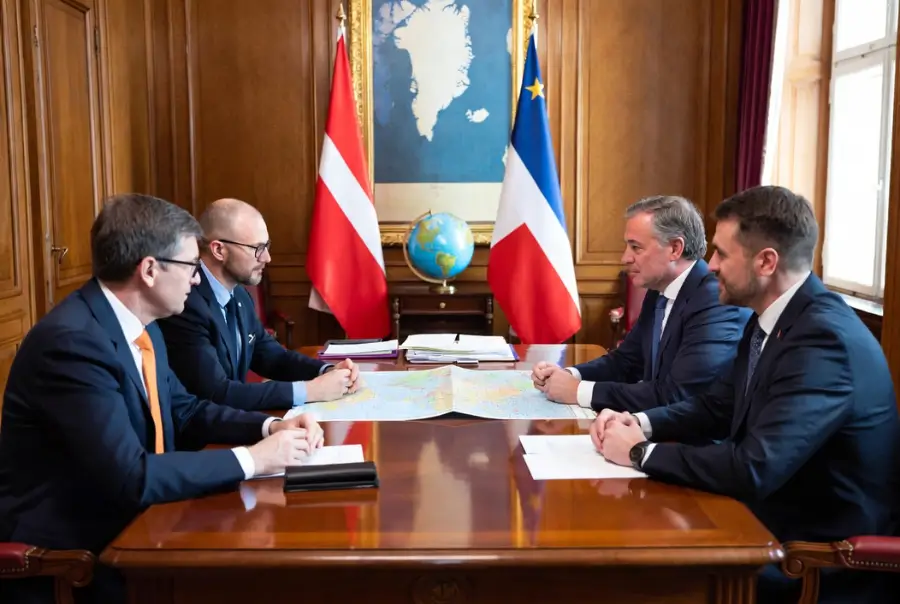
Trump’s Tariff Ultimatum Over Greenland Stuns European Allies

The announcement came without warning, shaking the foundations of transatlantic relations. President Donald Trump declared a series of tariffs aimed at several European nations, framing the move as a necessary step to secure American interests in the Arctic. This decision, tied directly to his longstanding desire to acquire Greenland from Denmark, has prompted urgent meetings among European leaders. As markets reacted with volatility, the White House maintained that the tariffs are a bargaining tool, not a declaration of war.
Greenland, the world’s largest island and an autonomous territory of Denmark, holds strategic importance due to its vast natural resources and position in the Arctic. Trump’s administration argues that control over the island is essential for national security, pointing to increasing activities by Russia and China in the region. European officials, however, view this as an overreach, emphasizing Greenland’s sovereignty and the potential damage to NATO unity.
The tariffs, set to begin at 10 percent on February 1 and escalate to 25 percent by June 1 if no agreement is reached, target goods from Denmark, Norway, Sweden, France, Germany, and others. This list includes key allies, raising questions about the long-term implications for international alliances. Financial analysts predict short-term disruptions in global trade, though some suggest the measures could lead to negotiations rather than prolonged conflict.
Historical Context of U.S. Interest in Greenland
American interest in Greenland dates back to the mid-20th century, when the United States established military bases there during World War II. The Thule Air Base, still operational today, underscores the island’s role in defense strategies. Trump’s previous attempts in 2019 to purchase Greenland were met with dismissal from Danish authorities, who called the idea absurd.
Recent developments have revived these discussions. Reports indicate that Trump’s team has cited climate change’s impact on the Arctic, opening new shipping routes and resource opportunities, as justification for renewed pressure. European leaders, including those from the European Union, have reportedly coordinated responses to counter what they see as economic coercion.
The island’s indigenous population has voiced strong opposition. Protests in Nuuk, Greenland’s capital, highlighted concerns over self-determination. Local officials have stated that any decision on the island’s future must involve Greenlanders directly, not be dictated by external powers.
NATO’s role adds another layer of complexity. As an alliance member, Denmark relies on collective defense, but Trump’s actions could strain these ties. Officials from the alliance have reportedly urged dialogue to prevent escalation, emphasizing shared security interests in the High North.
Economic Ramifications and Market Responses
Global markets felt the immediate impact of Trump’s announcement. Stock indices in Europe dipped, with sectors like manufacturing and exports hit hardest. The euro weakened against the dollar, reflecting investor uncertainty. Analysts from major financial institutions project that prolonged tariffs could shave points off GDP growth for affected countries.
In response, the European Union is preparing countermeasures valued at up to 93 billion euros. These include potential tariffs on American goods and restrictions on U.S. companies’ access to European markets. Such steps, described by EU officials as a “trade bazooka,” aim to deter further aggression while pushing for talks at venues like the World Economic Forum in Davos.
Business leaders on both sides of the Atlantic have called for restraint. Trade associations warn that escalating tariffs could disrupt supply chains, particularly in technology and energy sectors. Some experts suggest that the real goal may be to secure expanded U.S. military presence on the island rather than outright ownership.
The energy market, sensitive to Arctic developments, saw fluctuations in oil and natural gas prices. Greenland’s untapped mineral reserves, including rare earth elements crucial for green technologies, make it a prize in the shift toward sustainable energy. Trump’s move reportedly seeks to ensure American dominance in these resources amid global competition.
Diplomatic Fallout and Future Prospects
Diplomatic channels buzz with activity as leaders seek to de-escalate. Phone calls between Trump and counterparts like Danish Prime Minister Mette Frederiksen reportedly focused on security cooperation without territorial concessions. The U.K., also targeted, has reiterated its commitment to NATO while opposing tariffs on allies.
Protests extend beyond Greenland, with demonstrations in European capitals decrying what participants call imperialistic behavior. Public opinion polls in Europe show rising concern over U.S. reliability as a partner, potentially affecting future collaborations on issues like climate change and counterterrorism.
Looking ahead, negotiations could pivot toward joint ventures rather than acquisition. Proposals for enhanced U.S.-European cooperation in Arctic research and defense might emerge as compromises. However, if tariffs proceed, they could mark a shift toward more fragmented global trade relations.
The situation underscores broader tensions in international law regarding territorial sovereignty. Legal experts note that forcible acquisition violates norms established post-World War II. Greenland’s status as a self-governing entity further complicates any unilateral actions.
As the February deadline approaches, all eyes are on Davos for potential breakthroughs. Trump’s strategy, blending economic pressure with security rhetoric, tests the resilience of longstanding alliances. Whether this leads to resolution or rupture remains uncertain, but the episode highlights the evolving dynamics of power in a multipolar world.
Media reporting for this story: 45% Left | 25% Right | 20% Center | 10% Unrated
FYI, I add facts to stories that often miss them. Join our Substack for ad-free updates on Greenland dispute or become a reporter and report any Greenland dispute developments yourself.